Create SEFRA inputs
Tom Peatman and Charles Edwards
06-Apr-2025
Source:vignettes/make_inputs.Rmd
make_inputs.RmdIntroduction
This vignette provides an example of the preparation of observed
captures and effort for incorporation in the 2025 CCSBT collaborative
seabird risk assessment, applied to a simple synthetic dataset. The
overall approach is identical to that used for the 2024 CCSBT seabird
risk assessment, apart from the process of loading in biological data
inputs. This has been updated to allow members to prepare their observed
captures and effort datasets using different sets of biological inputs,
e.g., different seabird density layers. There has also been a minor
change to the arguments of get_overlap, which is also
described below.
Set up an R session for data preparation
Load packages required for data preparation and visualisation:
library(sefraInputs)
library(ggplot2)
library(sf)
library(kableExtra)
library(dplyr)
library(tidyr)

sf::sf_use_s2(FALSE)
options(dplyr.summarise.inform = FALSE)
Create a local directory in which to save the groomed data necessary for analysis. For the current demonstration, we use the temporary folder generated as part of the active R session:
The dir_data directory should not have any groomed data
or outputs from previous data preparation attempts, to avoid issues with
version control. The following will remove all ‘R’ data (i.e. files with
.rda or .RData extensions) and TeX (.tex extensions) files in the
dir_data folder and any sub-folders:
make_folder(dir_data, clean = TRUE)## directory createdHere, we define characters that should not be used in User defined names, e.g. for species groups, fishery groups, time periods, etc.:
Minimum data requirements
Raw observed effort and seabird captures data from pelagic longliners should be stored and accessed using custom scripts developed by the User. We recommend that observed effort and observed seabird captures are sourced separately, and we will assume this to be the case.
The minimum requirements for these data are described here, with required column headers:
Both the observed effort and captures data must include variables for:
flag(ISO 3166-1 alpha-3 country code),year,month, latitude (lat) and longitude (lon). Additional covariates will be required if they are needed to definefishery_groupfor the purposes of estimating catchabilities. Typically,fishery_groupwill be defined by theflag, but it is possible to define the fishery group using other covariates, e.g. target species.Observed effort should be provided with units of thousand hooks (
observer_effort). Observer effort can be summed perflag,year,month,lat,lonandfishery_groupto reduce file size.Observed captures should be provided with variables for species code (
code), status at-vessel (status=alive,deadorNAfor unknown), and number of individuals captured (n_captures). Information on age-class of captures should also be provided where available (age_class=adult,immature,juvenile,NA). Although this information is not currently incorporated in the risk assessment model, inclusion of data on the age-class of captures will allow the preparation of high-level summaries of captures by age-class.The
latandloncovariates must correspond to the centre of a 5x5 degree spatial grid or finer, to be compatible with the seabird density maps. See the ‘Spatial grid definition’ section for more information on the spatial structure of observer data. The observer data can be provided by the User at any spatial resolution, so long as each record can be attributed to a single cell in (see?grid). Because the population density maps are at a 5x5 degree resolution, and the data are summed across space to create a measure of overlap, there is no advantage to preparing the data at a finer resolution.The temporal resolution of the observer data must be (at a minimum) by
yearandmonth, to be compatible with the seabird density maps.To ensure that catchabilities are correctly estimated, the catch and effort data must be correctly matched. This means that the capture data must be from strata represented in the observer effort data, and that matching columns contain equivalent information in an equivalent format. As part of the data grooming process, observed captures are linked to the corresponding observed effort, and an identical stratification of the data is therefore necessary. If there are captures outside of the spatial or temporal range of the observer effort data, these captures should be removed until the source of the error is identified. This forms a part of data preparation scripts below.
Check observer data meet minimum requirements
Get totals for initial observed effort and captures. These allow the effects of data filtering to be reported:
Functions check_obs_effort and
check_obs_captures should be used to ensure that the
observer data meet the minimum requirements:
check_observed_effort(obs_effort)
check_observed_captures(obs_captures)
Additionally, the User may also assign
check_observed_effort and
check_observed_captures to filter out NAs in
the appropriate variables:
obs_effort   <- check_observed_effort(obs_effort)
obs_captures <- check_observed_captures(obs_captures)
The stratification of obs_effort and
obs_captures should be identical, and there should not be
strata with observed captures but no observed effort.
Get the variables that define the stratification of the observer data
(strata_vars), and ensure that they are present in both the
observer effort and capture data:
# Variables that define stratification of observed effort data
strata_vars <- colnames(obs_effort)[!colnames(obs_effort) %in% "observer_effort"]
stopifnot(all(strata_vars %in% colnames(obs_effort), strata_vars %in% colnames(obs_captures)))
Check that each record in obs_captures matches at most
one record in obs_effort:
obs_effort %>% left_join(., obs_captures, by = strata_vars, relationship = "one-to-many") %>% invisible(.)This will return an error if a record in obs_captures
matches multiple records in obs_effort (due to the
relationship argument).
There should not be multiple records in the observer effort data for a particular strata, as this would introduce duplication in captures data when they are joined:
# effort records per strata
effort_records_per_strata <- obs_effort %>%
  group_by_at(., strata_vars) %>%
  summarise(., n = n())

stopifnot(max(effort_records_per_strata$n) == 1)
Filter out captures for strata with no corresponding observed effort data:
Summarise remaining observed effort and captures after initial filtering:
Synthetic datasets used in this vignette
In this vignette, we demonstrate how data can be prepared and saved
to the directory dir_data on the User’s machine, using the
synthetic data provided with this package build. The synthetic data
consists of two files:
Observed effort data in
obs_effort.Observed seabird captures in
obs_captures.
These are loaded into the current R session, for
demonstration of the code:
data(obs_effort, obs_captures)The synthetic observed effort and captures data have the following structure:
| flag | target | year | month | lon | lat | observer_effort |
|---|---|---|---|---|---|---|
| NZL | BET+YFT | 2020 | 1 | 72.5 | -32.5 | 100 |
| NZL | ALB | 2020 | 4 | 77.5 | -32.5 | 130 |
| NZL | ALB | 2020 | 7 | 82.5 | -32.5 | 160 |
| NZL | BET+YFT | 2020 | 10 | 87.5 | -32.5 | 190 |
| NZL | BET+YFT | 2021 | 1 | 72.5 | -27.5 | 200 |
| NZL | ALB | 2021 | 4 | 77.5 | -27.5 | 230 |
| flag | target | year | month | lon | lat | code | status | age_class | n_captures |
|---|---|---|---|---|---|---|---|---|---|
| NZL | ALB | 2020 | 4 | 77.5 | -32.5 | DIW | alive | adult | 2 |
| NZL | ALB | 2020 | 4 | 77.5 | -32.5 | DIW | alive | immature | 1 |
| NZL | ALB | 2020 | 4 | 77.5 | -32.5 | DIW | dead | NA | 1 |
| NZL | ALB | 2020 | 4 | 77.5 | -32.5 | DIW | NA | NA | 1 |
| NZL | ALB | 2020 | 4 | 77.5 | -32.5 | DIW | alive | adult | 1 |
| NZL | ALB | 2020 | 4 | 77.5 | -32.5 | DIW | alive | NA | 2 |
The synthetic data are provided at a 5x5 degree spatial resolution, where the longitude and latitude fields provide the mid-point of the 5 degree square grid cell.
Check that synthetic observer data meet minimum requirements
Get totals for initial observed effort and captures:
obs_effort   <- check_observed_effort(obs_effort)
obs_captures <- check_observed_captures(obs_captures)
Get the variables that define the stratification of the observer data
(strata_vars), and ensure that they are present in both the
observer effort and capture data:
strata_vars <- colnames(obs_effort)[!colnames(obs_effort) %in% "observer_effort"]
stopifnot(all(strata_vars %in% colnames(obs_effort), strata_vars %in% colnames(obs_captures)))
Check that each record in obs_captures matches at most
one record in obs_effort:
obs_effort %>% left_join(., obs_captures, by = strata_vars, relationship = "one-to-many") %>% invisible(.)Check for multiple records in the observer effort data for a particular strata, which would introduce duplication in captures data when they are joined:
# effort records per strata
effort_records_per_strata <- obs_effort %>%
  group_by_at(., strata_vars) %>%
  summarise(., n = n())

stopifnot(max(effort_records_per_strata$n) == 1)
Filter out captures for strata with no corresponding observed effort data:
Summarise remaining observed effort and captures after initial filtering:
## Observed effort after check_observed_effort accounts for 100% of total observed effort provided by User## Observed captures after check_observed_effort and check_observed_captures accounts for 100% of total observed captures provided by UserAccess biological input data for the risk assessment model
As described above, this section has been updated for the 2025 CCSBT risk assessment, to allow preparation of data inputs with different sets of biological inputs.
Biological input data for the risk assessment model, including
demographic parameters and seabird density maps, are available through
the sefraInputs package. The biological inputs can be
accessed using the sefra_data function.
Calling the sefra_data function with no arguments
returns a summary of available biological inputs:
## Available SEFRA data:## name description
## 1 inputsBio 2024_CCSBT_SRA
## 2 inputsBio reference
## 3 cryptic_capture_longline reference
## 4 density_maps 2024_CCSBT_SRA
## 5 density_maps 2024_CCSBT_SRA_combined_range_maps
## 6 density_maps reference
## 7 density_maps reference_combined_range_maps
## created version id
## 1 2025-03-27 12:25:55 20250327T112555Z-1dd6f 1
## 2 2025-03-27 12:25:55 20250327T112555Z-ed41c 2
## 3 2025-03-27 12:25:55 20250327T112555Z-240cc 1
## 4 2025-03-27 12:26:01 20250327T112601Z-e6ac4 1
## 5 2025-03-27 12:26:02 20250327T112602Z-80743 2
## 6 2025-03-27 12:26:03 20250327T112603Z-92e7d 3
## 7 2025-03-27 12:26:04 20250327T112604Z-a6ad2 4Other data objects that are required, or helpful, when preparing data
inputs can be accessed through a call to data(). To check
what data are available in the current package build, use:
data(package = "sefraInputs")Demographic parameters
To load the current biological inputs into the global environment
(i.e., the inputsBio object) , we select the object where
description = "reference":
sefra_data("inputsBio", description = "reference")## Loaded data:##
##
## |name |description |created |version | id|
## |:---------|:-----------|:-------------------|:----------------------|--:|
## |inputsBio |reference |2025-03-27 12:25:55 |20250327T112555Z-ed41c | 2|The biological inputs for the 2024 CCSBT risk assessment are also
available (i.e., description = "2024_CCSBT_SRA").
Biological inputs will updated and added the sefraInputs
package as the project progresses.
inputsBio is a list object, with each element providing
the inputs for one biological or demographic variable. Each set of
biological inputs contains the following data frames: sp_codes,
sp_groups, breeding_season, p_nest, breeding_phenology, p_southern,
N_BP, P_B, S_curr, S_opt, A_curr, A_opt. This approach is intended to
facilitate data preparation with different biological inputs, e.g., for
sensitivity analyses.
Here, we prepare the synthetic observer dataset using the current best estimates of the biological inputs:
inputs_bio_option <- inputsBioCreate a separate object for each element of
inputs_bio_option:
invisible(sapply(names(inputs_bio_option), function(i) {
  assign(i, value = inputs_bio_option[[i]], envir = .GlobalEnv)
  message("Created ", i)
}))
## Created sp_codes## Created sp_groups## Created breeding_season## Created p_nest## Created breeding_phenology## Created p_southern## Created N_BP## Created P_B## Created S_curr## Created S_opt## Created A_curr## Created A_optTo retrieve the species list:
assign("species", value = inputs_bio_option[["sp_codes"]][,"code"], envir = .GlobalEnv)Seabird density maps
To load the current seabird density maps into the global environment
(i.e., the density_maps object) , we select the object
where description = "reference":
sefra_data("density_maps", description = "reference")## Loaded data:##
##
## |name |description |created |version | id|
## |:------------|:-----------|:-------------------|:----------------------|--:|
## |density_maps |reference |2025-03-27 12:26:03 |20250327T112603Z-92e7d | 3|Density maps will updated and added the sefraInputs
package as the project progresses, e.g., updated density maps for
selected species with additional tracking data, and density maps
incorporating range maps from Birdlife International.
Here, we prepare the synthetic observer dataset using the current best estimates of the biological inputs:
density_maps_option <- density_mapsCreate a separate object for each element of
density_maps:
invisible(sapply(names(density_maps_option), function(i) {
  assign(paste0("densities_", i), value = density_maps_option[[i]], envir = .GlobalEnv)
  message("Created ", paste0("densities_", i))
}))
## Created densities_dam## Created densities_dbn## Created densities_dcr## Created densities_dcu## Created densities_der## Created densities_dic## Created densities_dim## Created densities_dip## Created densities_diq## Created densities_diw## Created densities_dix## Created densities_dks## Created densities_dnb## Created densities_dqs## Created densities_dsb## Created densities_pci## Created densities_pcn## Created densities_pcw## Created densities_phe## Created densities_phu## Created densities_prk## Created densities_pro## Created densities_tqh## Created densities_tqw## Created densities_twdSpatial grid definition
The seabird density maps all have the same 5 degree spatial
structure. This 5 degree grid (called grid) is included in
the sefraInputs package, to facilitate the preparation of
observed effort data with a spatial structure and coordinate reference
system that is consistent with the seabird density maps (see
?grid). This consistency in spatial structures and
coordinate reference systems is required to estimate the spatial overlap
between fishing effort and seabird populations.
The grid is accessible using:
data("grid", package = "sefraInputs")The grid is a sf object, with each 5 x 5
degree cell represented as a polygon. The grid has an
associated coordinate reference system (see st_crs(grid).
During the data preparation, the User’s observer data must be converted
to a sf object, with the same coordinate reference system
as grid. This is done for the example dataset in Section
‘Format obs_data for calculation of density overlap’.
Seabird species, and species groupings of catchabilities
Species in the risk assessment model
The sp_codes data frame provides numeric species
identifiers (id_species), species codes (code
- using FAO ASFIS three-alpha codes where available), and common names
(common_name), for the seabird species included in the risk
assessment model:
| id_species | code | common_name |
|---|---|---|
| 1 | DIW | Gibson’s albatross |
| 2 | DQS | Antipodean albatross |
| 3 | DIX | Wandering albatross |
| 4 | DBN | Tristan albatross |
| 5 | DAM | Amsterdam albatross |
| 6 | DIP | Southern royal albatross |
Species groupings for estimation of catchabilities
Catchability parameters define catch rates per unit of observed density overlap. Catchability parameters can be shared across species, e.g. on the basis of similarities in behaviour when attending fishing vessels.
The sp_groups data frame is used to define the species
groupings used to estimate catchabilities, i.e., the
species_group and id_species_group
variables.
The sp_groups object in
inputsBio[['reference']] provides the species groupings
used in the 2024 seabird risk assessment:
sp_groups %>% filter(., !is.na(id_species_group)) %>%
  select(., id_species_group, species_group) %>% distinct(.) %>%
  arrange(., id_species_group) %>%
kable(.)| id_species_group | species_group |
|---|---|
| 1 | Wandering albatross |
| 2 | Royal albatross |
| 3 | Small albatross |
| 4 | Sooty albatross |
| 5 | Medium petrel |
However, the species groupings can be updated by the User for application to their observer data (see the following sub-section).
The sp_groups data frame also includes records for
seabird captures that were not recorded to a species level. This allows
all observed seabird captures to inform the risk assessment model, even
if the captures were not identified to a species-level. The variable
taxonomic_resolution defines whether the code
reflects identifications to a species level, species
complex (complex), genus or
family level.
The data field fao_code is a logical variable indicating
whether the code is a FAO ASFIS code (TRUE) or
not (FALSE). id_code provides a unique
(integer) identifier for each record.
Codes are also provided for captures that are identified to a finer
taxonomic resolution than genus, but a coarser resolution than species.
We refer to these as been having identified to a ‘species complex’
level. The following records in sp_groups give the codes
that should be used for captures identified to a ‘species complex’
level:
| common_name | scientific_name | genus | family | species_group | catchability_group | capture_group | id_code | id_genus | id_family | code | taxonomic_resolution | fao_code | id_species | id_species_group |
|---|---|---|---|---|---|---|---|---|---|---|---|---|---|---|
| Gibson’s and Antipodean albatross | Diomedea antipodensis gibsoni and D. a. antipodensis | Diomedea | Diomedeidae | NA | NA | Great albatross | 26 | 1 | 1 | DGA | complex | FALSE | NA | NA |
| Royal albatrosses | Diomedea epomophora and D. sanfordi | Diomedea | Diomedeidae | NA | NA | Great albatross | 27 | 1 | 1 | DRA | complex | FALSE | NA | NA |
| Yellow-nosed albatrosses | Thalassarche chlororhynchos and T. carteri | Thalassarche | Diomedeidae | NA | NA | Mollymawk | 28 | 2 | 1 | DYN | complex | FALSE | NA | NA |
| Shy-type albatross | Thalassarche cauta and T. c. steadi | Thalassarche | Diomedeidae | NA | NA | Mollymawk | 29 | 2 | 1 | DST | complex | FALSE | NA | NA |
| Black-browed albatrosses | Thalassarche melanophris and T. impavida | Thalassarche | Diomedeidae | NA | NA | Mollymawk | 30 | 2 | 1 | DBB | complex | FALSE | NA | NA |
| Buller’s albatross | Thalassarche bulleri bulleri and T. bulleri platei | Thalassarche | Diomedeidae | NA | NA | Mollymawk | 31 | 2 | 1 | DIB | complex | TRUE | NA | NA |
| Wandering albatross complex | Diomedea exulans, D. dabbenena, D. amsterdamensis, D. antipodensis gibsoni and D. a. antipodensis | Diomedea | Diomedeidae | NA | NA | Great albatross | 32 | 1 | 1 | DWC | complex | FALSE | NA | NA |
| Petrel complex | Procellaria parkinsoni, P. westlandica and P. aequinoctialis | Procellaria | Procellariidae | NA | NA | Medium petrel | 33 | 4 | 2 | PRZ | complex | FALSE | NA | NA |
The following records in sp_groups give the codes that
should be used for captures identified to a genus level:
| common_name | scientific_name | genus | family | species_group | catchability_group | capture_group | id_code | id_genus | id_family | code | taxonomic_resolution | fao_code | id_species | id_species_group |
|---|---|---|---|---|---|---|---|---|---|---|---|---|---|---|
| Diomedea spp | Diomedea spp | Diomedea | Diomedeidae | NA | NA | Great albatross | 34 | 1 | 1 | DIZ | genus | FALSE | NA | NA |
| Thalassarche spp | Thalassarche spp | Thalassarche | Diomedeidae | NA | NA | Mollymawk | 35 | 2 | 1 | THZ | genus | FALSE | NA | NA |
| Phoebetria spp | Phoebetria spp | Phoebetria | Diomedeidae | NA | NA | Sooty albatross | 36 | 3 | 1 | PHZ | genus | FALSE | NA | NA |
| Procellaria spp | Procellaria spp | Procellaria | Procellariidae | NA | NA | Medium petrel | 37 | 4 | 2 | PTZ | genus | TRUE | NA | NA |
The following records in sp_groups give the codes that
should be used for captures identified to a family level:
| common_name | scientific_name | genus | family | species_group | catchability_group | capture_group | id_code | id_genus | id_family | code | taxonomic_resolution | fao_code | id_species | id_species_group |
|---|---|---|---|---|---|---|---|---|---|---|---|---|---|---|
| Diomedeidae | Diomedeidae | NA | Diomedeidae | NA | NA | Unassigned | 38 | NA | 1 | ALZ | family | TRUE | NA | NA |
| Procellariidae | Procellariidae | NA | Procellariidae | NA | NA | Unassigned | 39 | NA | 2 | PRX | family | TRUE | NA | NA |
There is also a record in sp_groups with the code that
should be used for captures that were not identified to a family
level:
| common_name | scientific_name | genus | family | species_group | catchability_group | capture_group | id_code | id_genus | id_family | code | taxonomic_resolution | fao_code | id_species | id_species_group |
|---|
Users must map their species codings for seabird captures to the
corresponding values in sp_codes and
sp_groups, so that captures are assigned to the correct
species group for estimation of catchabilities.
Additional records in sp_groups may be required to
facilitate this mapping, for example, if there are captures with codes
that reflect identifications to a finer taxonomic resolution than genus,
but with a coarser resolution than species. Users should request
additional records by creating an Issue for
the sefraInputs Github repository.
It is essential that Users request additional records to be added to
the sp_groups object in the R package if
necessary, rather than working off a modified local version of
sp_groups. This will ensure that all members have
consistent codes (code) and identifiers
(id_code) in their captures datasets.
Updating species groupings for estimation of catchabilities
Species groups may need to be adjusted for application to the User’s observer dataset.
If this is required, the function assign_species_groups
should be used to update the sp_groups object, based on a
lookup table provided by the User called
species_group_definitions. The updated species groups in
sp_groups will then propagate through to the observed
captures and observed overlap.
The User should not manually adjust species groups directly in the
data objects, i.e., do not directly adjust species_group or
id_species_group in obs_data,
obs_overlap, overlap_o,
captures_o, etc.
For example, to define species groups using genus, i.e., grouping all great albatrosses (Diomedea species) together, the User should run the following:
# Initial species groupings
sp_groups_init <- sp_groups

# Updated species group definitions for separate groups per genus
genus_list <- unique(sp_groups$genus)
genus_list <- genus_list[!is.na(genus_list)]
species_group_definitions <- data.frame(id_species_group = 1:length(genus_list), genus = genus_list, species_group = genus_list)

stopifnot(all(!grepl(latex_special_characters, species_group_definitions$species_group)))
stopifnot(all(!grepl(punctuation_characters, species_group_definitions$species_group)))

# Assign updated species groups
sp_groups <- assign_species_groups(sp_groups, species_group_definitions, by = "genus")
Species group names (species_group) can have spaces, but
should not have punctuation characters, or special characters in LaTeX,
e.g. underscores (_), ampersands (&), dollar signs ($) etc.
To prepare the synthetic data, we use the species groups from the 2024 CCSBT seabird risk assessment. Members should also use these species groups when preparing their data for inclusion in the combined dataset (i.e., the dataset that includes data from all participating members), as consistent species groups must be used by all members.
First, ensure that the sp_groups has not been
updated:
if(!isTRUE(all.equal(sp_groups, inputs_bio_option[["sp_groups"]]))) {
  message("Resetting species groups to inputs_bio_option[['sp_groups']]")
  sp_groups <- inputs_bio_option[["sp_groups"]]
}
The species groups are:
kable(sp_groups, caption = "Species groups used to prepare the synthetic dataset.")| common_name | scientific_name | genus | family | species_group | catchability_group | capture_group | id_code | id_genus | id_family | code | taxonomic_resolution | fao_code | id_species | id_species_group |
|---|---|---|---|---|---|---|---|---|---|---|---|---|---|---|
| Gibson’s albatross | Diomedea antipodensis gibsoni | Diomedea | Diomedeidae | Wandering albatross | Wandering albatross | Great albatross | 1 | 1 | 1 | DIW | species | TRUE | 1 | 1 |
| Antipodean albatross | Diomedea antipodensis antipodensis | Diomedea | Diomedeidae | Wandering albatross | Wandering albatross | Great albatross | 2 | 1 | 1 | DQS | species | TRUE | 2 | 1 |
| Wandering albatross | Diomedea exulans | Diomedea | Diomedeidae | Wandering albatross | Wandering albatross | Great albatross | 3 | 1 | 1 | DIX | species | TRUE | 3 | 1 |
| Tristan albatross | Diomedea dabbenena | Diomedea | Diomedeidae | Wandering albatross | Wandering albatross | Great albatross | 4 | 1 | 1 | DBN | species | TRUE | 4 | 1 |
| Amsterdam albatross | Diomedea amsterdamensis | Diomedea | Diomedeidae | Wandering albatross | Wandering albatross | Great albatross | 5 | 1 | 1 | DAM | species | TRUE | 5 | 1 |
| Southern royal albatross | Diomedea epomophora | Diomedea | Diomedeidae | Royal albatross | Royal albatross | Great albatross | 6 | 1 | 1 | DIP | species | TRUE | 6 | 2 |
| Northern royal albatross | Diomedea sanfordi | Diomedea | Diomedeidae | Royal albatross | Royal albatross | Great albatross | 7 | 1 | 1 | DIQ | species | TRUE | 7 | 2 |
| Atlantic yellow-nosed albatross | Thalassarche chlororhynchos | Thalassarche | Diomedeidae | Small albatross | Mollymawk | Mollymawk | 8 | 2 | 1 | DCR | species | TRUE | 8 | 3 |
| Indian yellow-nosed albatross | Thalassarche carteri | Thalassarche | Diomedeidae | Small albatross | Mollymawk | Mollymawk | 9 | 2 | 1 | TQH | species | TRUE | 9 | 3 |
| Black-browed albatross | Thalassarche melanophris | Thalassarche | Diomedeidae | Small albatross | Mollymawk | Mollymawk | 10 | 2 | 1 | DIM | species | TRUE | 10 | 3 |
| Campbell black-browed albatross | Thalassarche impavida | Thalassarche | Diomedeidae | Small albatross | Mollymawk | Mollymawk | 11 | 2 | 1 | TQW | species | TRUE | 11 | 3 |
| Shy albatross | Thalassarche cauta | Thalassarche | Diomedeidae | Small albatross | Mollymawk | Mollymawk | 12 | 2 | 1 | DCU | species | TRUE | 12 | 3 |
| New Zealand white-capped albatross | Thalassarche cauta steadi | Thalassarche | Diomedeidae | Small albatross | Mollymawk | Mollymawk | 13 | 2 | 1 | TWD | species | TRUE | 13 | 3 |
| Salvin’s albatross | Thalassarche salvini | Thalassarche | Diomedeidae | Small albatross | Mollymawk | Mollymawk | 14 | 2 | 1 | DKS | species | TRUE | 14 | 3 |
| Chatham Island albatross | Thalassarche eremita | Thalassarche | Diomedeidae | Small albatross | Mollymawk | Mollymawk | 15 | 2 | 1 | DER | species | TRUE | 15 | 3 |
| Grey-headed albatross | Thalassarche chrysostoma | Thalassarche | Diomedeidae | Small albatross | Mollymawk | Mollymawk | 16 | 2 | 1 | DIC | species | TRUE | 16 | 3 |
| Southern Buller’s albatross | Thalassarche bulleri bulleri | Thalassarche | Diomedeidae | Small albatross | Mollymawk | Mollymawk | 17 | 2 | 1 | DSB | species | FALSE | 17 | 3 |
| Northern Buller’s albatross | Thalassarche bulleri platei | Thalassarche | Diomedeidae | Small albatross | Mollymawk | Mollymawk | 18 | 2 | 1 | DNB | species | FALSE | 18 | 3 |
| Sooty albatross | Phoebetria fusca | Phoebetria | Diomedeidae | Sooty albatross | Sooty albatross | Sooty albatross | 19 | 3 | 1 | PHU | species | TRUE | 19 | 4 |
| Light-mantled sooty albatross | Phoebetria palpebrata | Phoebetria | Diomedeidae | Sooty albatross | Sooty albatross | Sooty albatross | 20 | 3 | 1 | PHE | species | TRUE | 20 | 4 |
| Grey petrel | Procellaria cinerea | Procellaria | Procellariidae | Medium petrel | Medium petrel | Medium petrel | 21 | 4 | 2 | PCI | species | TRUE | 21 | 5 |
| Black petrel | Procellaria parkinsoni | Procellaria | Procellariidae | Medium petrel | Medium petrel | Medium petrel | 22 | 4 | 2 | PRK | species | TRUE | 22 | 5 |
| Westland petrel | Procellaria westlandica | Procellaria | Procellariidae | Medium petrel | Medium petrel | Medium petrel | 23 | 4 | 2 | PCW | species | TRUE | 23 | 5 |
| White-chinned petrel | Procellaria aequinoctialis | Procellaria | Procellariidae | Medium petrel | Medium petrel | Medium petrel | 24 | 4 | 2 | PRO | species | TRUE | 24 | 5 |
| Spectacled petrel | Procellaria conspicillata | Procellaria | Procellariidae | Medium petrel | Medium petrel | Medium petrel | 25 | 4 | 2 | PCN | species | TRUE | 25 | 5 |
| Gibson’s and Antipodean albatross | Diomedea antipodensis gibsoni and D. a. antipodensis | Diomedea | Diomedeidae | NA | NA | Great albatross | 26 | 1 | 1 | DGA | complex | FALSE | NA | NA |
| Royal albatrosses | Diomedea epomophora and D. sanfordi | Diomedea | Diomedeidae | NA | NA | Great albatross | 27 | 1 | 1 | DRA | complex | FALSE | NA | NA |
| Yellow-nosed albatrosses | Thalassarche chlororhynchos and T. carteri | Thalassarche | Diomedeidae | NA | NA | Mollymawk | 28 | 2 | 1 | DYN | complex | FALSE | NA | NA |
| Shy-type albatross | Thalassarche cauta and T. c. steadi | Thalassarche | Diomedeidae | NA | NA | Mollymawk | 29 | 2 | 1 | DST | complex | FALSE | NA | NA |
| Black-browed albatrosses | Thalassarche melanophris and T. impavida | Thalassarche | Diomedeidae | NA | NA | Mollymawk | 30 | 2 | 1 | DBB | complex | FALSE | NA | NA |
| Buller’s albatross | Thalassarche bulleri bulleri and T. bulleri platei | Thalassarche | Diomedeidae | NA | NA | Mollymawk | 31 | 2 | 1 | DIB | complex | TRUE | NA | NA |
| Wandering albatross complex | Diomedea exulans, D. dabbenena, D. amsterdamensis, D. antipodensis gibsoni and D. a. antipodensis | Diomedea | Diomedeidae | NA | NA | Great albatross | 32 | 1 | 1 | DWC | complex | FALSE | NA | NA |
| Petrel complex | Procellaria parkinsoni, P. westlandica and P. aequinoctialis | Procellaria | Procellariidae | NA | NA | Medium petrel | 33 | 4 | 2 | PRZ | complex | FALSE | NA | NA |
| Diomedea spp | Diomedea spp | Diomedea | Diomedeidae | NA | NA | Great albatross | 34 | 1 | 1 | DIZ | genus | FALSE | NA | NA |
| Thalassarche spp | Thalassarche spp | Thalassarche | Diomedeidae | NA | NA | Mollymawk | 35 | 2 | 1 | THZ | genus | FALSE | NA | NA |
| Phoebetria spp | Phoebetria spp | Phoebetria | Diomedeidae | NA | NA | Sooty albatross | 36 | 3 | 1 | PHZ | genus | FALSE | NA | NA |
| Procellaria spp | Procellaria spp | Procellaria | Procellariidae | NA | NA | Medium petrel | 37 | 4 | 2 | PTZ | genus | TRUE | NA | NA |
| Diomedeidae | Diomedeidae | NA | Diomedeidae | NA | NA | Unassigned | 38 | NA | 1 | ALZ | family | TRUE | NA | NA |
| Procellariidae | Procellariidae | NA | Procellariidae | NA | NA | Unassigned | 39 | NA | 2 | PRX | family | TRUE | NA | NA |
| Bird | Aves | NA | NA | NA | NA | Unassigned | 40 | NA | NA | BLZ | class | FALSE | NA | NA |
Save sp_groups and (if necessary)
species_groups_definitions for use in the risk assessment
model:
Prepare observed effort and captures data
Specify the time-period for observations used to estimate catchabilities
There is a compromise when specifying the time-period from which observer data are used to estimate catchabilities. Seabird captures are relatively rare, and so longer time-series of observer data may be preferred in order to inform the model. However, earlier observer data may be less reliable, e.g., if observer training on seabird identification and monitoring for seabird captures was less robust in earlier years. Furthermore, population sizes of the birds being caught will have changed over time.
fishing_years_fit defines the years from which observer
data are used to estimate catchabilities. This is saved as part of the
data preparation process. In our example, we use all available observer
data:
fishing_years_fit <- 2020:2021
save(fishing_years_fit, file = file.path(dir_data, "fishing_years_fit.rda"))
The observer data are then filtered to keep data from the appropriate time period:
Combine observed effort with capture data
Get total observed effort and captures, which will be used to check that total captures have been preserved:
Add the (numeric) code ID (id_code) to the capture
data:
obs_captures <- sp_groups %>%
  dplyr::select(., code, id_code) %>%
  left_join(obs_captures, ., by = "code")
Check for observed captures of species codes not included in the risk assessment model:
## Observed captures of species codes not included in the risk assessment model account for 100% of total observed seabird capturesRestructure the captures data to have one record per strata:
obs_captures <- obs_captures %>%
  group_by_at(strata_vars) %>%
  summarise(code = list(code),
            id_code = list(id_code),
            captures_status = list(status),
            age_class = list(age_class),
            n_captures = list(n_captures)) %>%
  data.frame(.)
Combine observed effort and captures, and check that total observed effort and captures have been preserved:
obs_data <- obs_effort %>% left_join(., obs_captures, by = strata_vars)
stopifnot(isTRUE(all.equal(sum(obs_data$observer_effort), N_EFFORT)))
stopifnot(isTRUE(all.equal(sum(unlist(obs_data$n_captures)), N_CAPTURES)))
Add a unique identifier to each record in obs_data
called record_id:
obs_data <- obs_data %>% mutate(., record_id = row_number())
obs_data <- obs_data %>% select(., record_id, everything())
The combined observer dataset has the following structure:
| record_id | flag | target | year | month | lon | lat | observer_effort | code | id_code | captures_status | age_class | n_captures |
|---|---|---|---|---|---|---|---|---|---|---|---|---|
| 1 | NZL | BET+YFT | 2020 | 1 | 72.5 | -32.5 | 100 | NULL | NULL | NULL | NULL | NULL |
| 2 | NZL | ALB | 2020 | 4 | 77.5 | -32.5 | 130 | DIW, DIW, DIW, DIW, DIW, DIW, DIZ, BLZ | 1, 1, 1, 1, 1, 1, 34, 40 | alive, alive, dead , NA , alive, alive, alive, dead | adult , immature, NA , NA , adult , NA , adult , NA | 2, 1, 1, 1, 1, 2, 1, 1 |
| 3 | NZL | ALB | 2020 | 7 | 82.5 | -32.5 | 160 | DCU, DCU, TWD, TWD, TWD, THZ, THZ | 12, 12, 13, 13, 13, 35, 35 | alive, alive, dead , dead , NA , alive, alive | adult , immature, adult , immature, NA , juvenile, NA | 5, 1, 2, 1, 1, 1, 2 |
| 4 | NZL | BET+YFT | 2020 | 10 | 87.5 | -32.5 | 190 | NULL | NULL | NULL | NULL | NULL |
| 5 | NZL | BET+YFT | 2021 | 1 | 72.5 | -27.5 | 200 | PCN, PCN, PCN, PCN, PTZ | 25, 25, 25, 25, 37 | alive, dead , dead , NA , alive | NA , immature, juvenile, NA , adult | 1, 11, 1, 1, 2 |
| 6 | NZL | ALB | 2021 | 4 | 77.5 | -27.5 | 230 | NULL | NULL | NULL | NULL | NULL |
| 7 | NZL | ALB | 2021 | 7 | 82.5 | -27.5 | 260 | NULL | NULL | NULL | NULL | NULL |
| 8 | NZL | BET+YFT | 2021 | 10 | 87.5 | -27.5 | 290 | PRO, PRO, PRO, PRO, PCN, PCN, PRX | 24, 24, 24, 24, 25, 25, 39 | alive, alive, dead , dead , dead , dead , alive | adult , juvenile, adult , NA , adult , immature, adult | 2, 1, 9, 1, 9, 2, 2 |
Assign fishery group IDs
It is necessary to assign ‘fishery groups’ to the observed effort and capture data. Catchabilities are estimated with a fishery group specific parameter, such that different fishery groups are more, or less, likely to capture seabirds, all else being equal. However, all observed effort could be represented by a single fishery group.
The function assign_fishery_groups assigns fishery
groups, defined as any combination of variables in the argument
lk_definitions. The variables defining fishery groups must
be present in both the observer dataset and the dataset of total effort
used to estimate total captures.
In this example, we define fishing groups based on target species.
First, create a look-up table called lk_fishery_groups
that provides a name for each fishery group (the
fishery_group variable):
lk_fishery_groups <- data.frame(id_fishery_group = c(1L, 2L), fishery_group = c("Albacore", "Tropical Tuna"))

stopifnot(all(!duplicated(lk_fishery_groups$id_fishery_group)))
stopifnot(is.integer(lk_fishery_groups$id_fishery_group))
stopifnot(all(!grepl(latex_special_characters, lk_fishery_groups$fishery_group)))
stopifnot(all(!grepl(punctuation_characters, lk_fishery_groups$fishery_group)))
id_fishery_group must be an integer.
fishery_group names can have spaces, but should not have
punctuation characters, or special characters in LaTeX, e.g. underscores
(_), ampersands (&), dollar signs ($) etc.
Then create a data frame called
fishery_group_definitions that defines fishery groups, in
this case based on target species:
fishery_group_definitions <- data.frame(id_fishery_group = c(1L, 2L), target = c("ALB", "BET+YFT"))
stopifnot(all(fishery_group_definitions$id_fishery_group %in% lk_fishery_groups$id_fishery_group))
The look-up table of fishery group names in this example
(lk_fishery_groups) is:
| id_fishery_group | fishery_group |
|---|---|
| 1 | Albacore |
| 2 | Tropical Tuna |
and the data frame defining the fishery groups
(fishery_group_definitions) is:
| id_fishery_group | target |
|---|---|
| 1 | ALB |
| 2 | BET+YFT |
Assign fishery groups to obs_data using
assign_fishery_groups:
obs_data <- assign_fishery_groups(obs_data, lk_definitions = fishery_group_definitions, lk_names = lk_fishery_groups)## Joining with `by = join_by(target)`As mentioned above, the User can choose to include all surface longline effort in a single fishery group. E.g., for observed effort of Japanese vessels, a single fishery group could be applied with:
lk_fishery_groups <- data.frame(id_fishery_group = 1L, fishery_group = "All")
fishery_group_definitions <- data.frame(id_fishery_group = 1L, flag = "JPN")

obs_data <- assign_fishery_groups(obs_data, lk_definitions = fishery_group_definitions, lk_names = lk_fishery_groups)
Check for observer data with no assigned fishery group:
## Observed effort with an assigned fishery group accounts for 100% of total observed effort
## (and 100% of total observed seabird captures)
Then save fishery_group_definitions and
lk_fishery_groups so that fishery groups can be assigned to
the total effort data (for the User’s longline fleet):
Assign time periods for catchabilities
Catchabilities can be estimated with time-varying catchabilities,
e.g., to reflect changes in seabird bycatch mitigation measures through
time. Similarly to fishery groups, the full time series of observer
could be considered as a single time period. The function
assign_time_periods assigns the periods of time in which
catchabilities are shared.
Here, for example purposes, we define separate time periods for 2020 and 2021.
Create a look-up table called lk_time_periods that
provides a name for each time period (the period
variable):
lk_time_periods <- data.frame(id_period = c(1L, 2L), period = c("early", "late"))

stopifnot(all(!duplicated(lk_time_periods$id_period)))
stopifnot(is.integer(lk_time_periods$id_period))
stopifnot(all(!grepl(latex_special_characters, lk_time_periods$period)))
stopifnot(all(!grepl(punctuation_characters, lk_time_periods$period)))
id_period must be an integer. period names
can have spaces, but should not have punctuation characters, or special
characters in LaTeX, e.g. underscores (_), ampersands (&), dollar
signs ($) etc.
Then, create a data frame called time_period_definitions
that defines separate time periods for each year:
time_period_definitions <- data.frame(id_period = c(1L, 2L), year = c(2020L, 2021L))
stopifnot(all(time_period_definitions$id_period %in% lk_time_periods$id_period))
The look-up table of time period names in this example
(lk_time_periods) is:
| id_period | period |
|---|---|
| 1 | early |
| 2 | late |
and the data frame defining the time periods
(time_period_definitions) is:
| id_period | year |
|---|---|
| 1 | 2020 |
| 2 | 2021 |
Now assign time periods to obs_data using
assign_time_period:
obs_data <- assign_time_periods(obs_data, lk_definitions = time_period_definitions, lk_names = lk_time_periods)## Joining with `by = join_by(year)`Check for observer data with no assigned time period:
## Observed effort with an assigned time period accounts for 100% of total observed effort
## (and 100% of total observed seabird captures)
Then save time_period_definitions and
lk_time_periods so that time periods can be assigned to the
total effort dataset (for the User’s longline fleet):
Remove records missing required information
Remove records missing required information to get observed density overlap with seabird distributions:
## Observed effort with required location and month information accounts for 100% of total observed effort
## (and 100% of total observed seabird captures)
Format obs_data for calculation of density overlap
First, convert month to give the abbreviated month name,
keeping month as an integer in a new field called
month_id:
obs_data$id_month <- obs_data$month
obs_data$month <- month.abb[obs_data$month]
stopifnot(all(!is.na(obs_data$month)))
The month variable is used to get the seabird density
map for the correct month for each record in obs_data.
The synthetic observer data are provided at a 5 degree resolution (matching the spatial resolution of the seabird density maps), with the provided latitude / longitude positions giving the mid-point of the 5 degree cell.
As described above, it is necessary for obs_data to be a
sf object, with the correct coordinate reference system, to
allow the calculation of overlap between fishing effort and seabird
distributions. The spatial information should be included in a variable
named geometry.
Reformat obs_data to be a sf object, with
the geometry variable representing the location of fishing
effort (provided as lat/lons):
obs_data <- obs_data %>%
  rowwise(.) %>%
  mutate(., geometry = list(st_point(c(lon, lat)))) %>%
  ungroup(.) %>%
  st_as_sf(., crs = "EPSG:4326")
The coordinate reference system of obs_data must be
transformed to that of grid to ensure a consistent
coordinate reference system with the seabird density maps:
obs_data <- obs_data %>% st_transform(crs = st_crs(grid))It is important to note that, when preparing your own data, the location of fishing effort does not necessarily need to be represented as a point. For example, polygons could be used for aggregated effort data. The most appropriate approach for the User will depend on their data structure, e.g., midpoints of cells or polygons are appropriate for data aggregated to a 1x1 or 5x5 resolution, whereas set locations can be used for set-level observer data.
Add unique cell identifiers from grid to
obs_data, to allow for model diagnostics with a spatial
dimension:
obs_data <- get_id_cell(obs_data, fun = min)Points that fall on a boundary between multiple 5 degree cells
(i.e. a boundary or intersection between polygons in grid)
are assigned the lowest id_cell from matching cells with
fun = min in get_id_cell calls. Note that
get_overlap uses the mean density across the appropriate
cells, for points on a boundary or intersection between multiple 5
degree cells.
The observer data have the following structure:
## sf [8 × 18] (S3: sf/tbl_df/tbl/data.frame)
##  $ record_id       : int [1:8] 1 2 3 4 5 6 7 8
##  $ flag            : chr [1:8] "NZL" "NZL" "NZL" "NZL" ...
##  $ target          : chr [1:8] "BET+YFT" "ALB" "ALB" "BET+YFT" ...
##  $ year            : int [1:8] 2020 2020 2020 2020 2021 2021 2021 2021
##  $ month           : chr [1:8] "Jan" "Apr" "Jul" "Oct" ...
##  $ lon             : num [1:8] 72.5 77.5 82.5 87.5 72.5 77.5 82.5 87.5
##  $ lat             : num [1:8] -32.5 -32.5 -32.5 -32.5 -27.5 -27.5 -27.5 -27.5
##  $ observer_effort : int [1:8] 100 130 160 190 200 230 260 290
##  $ code            :List of 8
##   ..$ : NULL
##   ..$ : chr [1:8] "DIW" "DIW" "DIW" "DIW" ...
##   ..$ : chr [1:7] "DCU" "DCU" "TWD" "TWD" ...
##   ..$ : NULL
##   ..$ : chr [1:5] "PCN" "PCN" "PCN" "PCN" ...
##   ..$ : NULL
##   ..$ : NULL
##   ..$ : chr [1:7] "PRO" "PRO" "PRO" "PRO" ...
##  $ id_code         :List of 8
##   ..$ : NULL
##   ..$ : int [1:8] 1 1 1 1 1 1 34 40
##   ..$ : int [1:7] 12 12 13 13 13 35 35
##   ..$ : NULL
##   ..$ : int [1:5] 25 25 25 25 37
##   ..$ : NULL
##   ..$ : NULL
##   ..$ : int [1:7] 24 24 24 24 25 25 39
##  $ captures_status :List of 8
##   ..$ : NULL
##   ..$ : chr [1:8] "alive" "alive" "dead" NA ...
##   ..$ : chr [1:7] "alive" "alive" "dead" "dead" ...
##   ..$ : NULL
##   ..$ : chr [1:5] "alive" "dead" "dead" NA ...
##   ..$ : NULL
##   ..$ : NULL
##   ..$ : chr [1:7] "alive" "alive" "dead" "dead" ...
##  $ age_class       :List of 8
##   ..$ : NULL
##   ..$ : chr [1:8] "adult" "immature" NA NA ...
##   ..$ : chr [1:7] "adult" "immature" "adult" "immature" ...
##   ..$ : NULL
##   ..$ : chr [1:5] NA "immature" "juvenile" NA ...
##   ..$ : NULL
##   ..$ : NULL
##   ..$ : chr [1:7] "adult" "juvenile" "adult" NA ...
##  $ n_captures      :List of 8
##   ..$ : NULL
##   ..$ : int [1:8] 2 1 1 1 1 2 1 1
##   ..$ : int [1:7] 5 1 2 1 1 1 2
##   ..$ : NULL
##   ..$ : int [1:5] 1 11 1 1 2
##   ..$ : NULL
##   ..$ : NULL
##   ..$ : int [1:7] 2 1 9 1 9 2 2
##  $ id_fishery_group: int [1:8] 2 1 1 2 2 1 1 2
##  $ id_period       : int [1:8] 1 1 1 1 2 2 2 2
##  $ id_month        : int [1:8] 1 4 7 10 1 4 7 10
##  $ geometry        :sfc_POINT of length 8; first list element:  'XY' num [1:2] -6087560 -801442
##  $ id_cell         : int [1:8] 771 772 773 774 843 844 845 846
##  - attr(*, "sf_column")= chr "geometry"
##  - attr(*, "agr")= Factor w/ 3 levels "constant","aggregate",..: NA NA NA NA NA NA NA NA NA NA ...
##   ..- attr(*, "names")= chr [1:17] "record_id" "flag" "target" "year" ...
Generate data inputs for the risk assessment model
Calculate density overlap of observed fishing effort with seabird distributions
Calculate density overlap by species:
obs_overlap <- obs_data %>% select(., record_id, flag, year, id_period, id_month, month, id_fishery_group, id_cell, observer_effort)
for (spp in species) {
  obs_overlap <- obs_overlap %>% get_overlap(., get(paste0("densities_", tolower(spp))), name = spp, effort_name = "observer_effort", group_name = "month")
}
Please note that get_overlap has been updated to take
the seabird density map as the y argument, rather than
taking the relevant density map from the global environment based on the
species code. For more information see ?get_overlap.
Now finished with spatial information in obs_overlap, so
remove spatial information:
obs_overlap <- obs_overlap %>% st_drop_geometry(.)
stopifnot(nrow(obs_data) == nrow(obs_overlap))
Aggregate observed density overlap
Create object overlap_o with aggregated observed overlap
for model fitting:
# Record for checking
OVERLAP_O <- sum(obs_overlap[, grepl("^overlap_", colnames(obs_overlap))], na.rm = TRUE)

# Generate data frame with aggregated observed overlap by species
overlap_o <- obs_overlap %>% aggregate_overlap(., flag, id_fishery_group, year, id_period, id_month, month, id_cell)

# Add species groups and taxonomic information
overlap_o <- sp_groups %>%
  dplyr::select(., code, id_code, id_species_group, id_species, id_genus, id_family) %>%
  left_join(overlap_o, ., by = "code")

# And reformat variables
overlap_o <- overlap_o %>%
  mutate(id_month = as.integer(id_month),
         id_period = as.integer(id_period),
         id_fishery_group = as.integer(id_fishery_group),
         id_cell = as.integer(id_cell),
         id_code = as.integer(id_code),
         id_species_group = as.integer(id_species_group),
         id_species = as.integer(id_species),
         id_genus = as.integer(id_genus),
         id_family = as.integer(id_family))

# Reorder variables
overlap_o <- overlap_o %>%
  dplyr::select(., flag, id_fishery_group, year, id_period, id_month, month, id_cell,
                code, id_code, id_species_group, id_species, id_genus, id_family, overlap)

# check no NA values
stopifnot(all(!is.na(overlap_o$overlap)))

# check overlap
stopifnot(isTRUE(all.equal(OVERLAP_O, sum(overlap_o$overlap))))
The structure of overlap_o is:
## tibble [200 × 14] (S3: tbl_df/tbl/data.frame)
##  $ flag            : chr [1:200] "NZL" "NZL" "NZL" "NZL" ...
##  $ id_fishery_group: int [1:200] 1 1 1 1 2 2 2 2 1 1 ...
##  $ year            : int [1:200] 2020 2020 2021 2021 2020 2020 2021 2021 2020 2020 ...
##  $ id_period       : int [1:200] 1 1 2 2 1 1 2 2 1 1 ...
##  $ id_month        : int [1:200] 4 7 4 7 1 10 1 10 4 7 ...
##  $ month           : chr [1:200] "Apr" "Jul" "Apr" "Jul" ...
##  $ id_cell         : int [1:200] 772 773 844 845 771 774 843 846 772 773 ...
##  $ code            : chr [1:200] "DAM" "DAM" "DAM" "DAM" ...
##  $ id_code         : int [1:200] 5 5 5 5 5 5 5 5 4 4 ...
##  $ id_species_group: int [1:200] 1 1 1 1 1 1 1 1 1 1 ...
##  $ id_species      : int [1:200] 5 5 5 5 5 5 5 5 4 4 ...
##  $ id_genus        : int [1:200] 1 1 1 1 1 1 1 1 1 1 ...
##  $ id_family       : int [1:200] 1 1 1 1 1 1 1 1 1 1 ...
##  $ overlap         : num [1:200] 1.88e-05 1.70e-05 1.53e-05 1.41e-05 1.47e-05 ...
overlap_o has a finer stratification than the resolution
of the risk assessment model. This allows for more detailed diagnostics
of the model fits to observed captures, both temporally and
spatially.
Aggregate observed captures to resolution of the risk assessment model
Get captures by ‘species code’, including individuals not identified to a species-level:
# Create a named vector of all codes (used in aggregate_captures call)
named_sp_codes <- sp_groups[, "code"]
names(named_sp_codes) <- named_sp_codes

captures_all <- obs_data %>%
  as.data.frame() %>%
  aggregate_captures(strata = c("flag", "id_fishery_group", "year", "id_period", "id_month", "month", "id_cell"), named_sp_codes) %>%
  rename(., code = group)
Get captures by status (alive / dead):
captures_alive <- obs_data %>% as.data.frame(.) %>%
  filter_captures(., field = "captures_status", condition = "alive") %>%
  aggregate_captures(., strata = c("flag", "id_fishery_group", "year", "id_period", "id_month", "id_cell"), named_sp_codes) %>%
  rename(., code = group)

captures_dead <- obs_data %>% as.data.frame(.) %>%
  filter_captures(., field = "captures_status", condition = "dead")  %>%
  aggregate_captures(., strata = c("flag", "id_fishery_group", "year", "id_period", "id_month", "id_cell"), named_sp_codes) %>%
  rename(., code = group)

captures_status <- full_join(
  captures_alive, captures_dead,
  by = c("flag", "id_fishery_group", "year", "id_period", "id_month", "id_cell", "code"),
  suffix = c("_alive", "_dead"))
## Captures without usable status information (i.e. not 'alive' or 'dead') = 3Combine observed captures data to include total individuals, and individuals by status:
captures_o <- sp_groups %>%
  dplyr::select(., id_code, id_species_group, id_species, id_genus, id_family, code, taxonomic_resolution) %>%
  left_join(., captures_all, by = "code", relationship = "one-to-many") %>%
  left_join(., captures_status, by = c("flag", "id_fishery_group", "year", "id_period", "id_month", "id_cell", "code"), relationship = "one-to-one")

captures_o <- captures_o %>% select(., flag, id_fishery_group, year, id_period, id_month, month, id_cell,
                                    code, id_code, id_species_group, everything())
For taxonomic ID fields in captures_o, replace
NAs with -1’s:
id_vars <- c("id_species", "id_species_group", "id_genus", "id_family")
captures_o[, id_vars] <- lapply(captures_o[, id_vars], function(x) {
  x[is.na(x)] <- -1L
  x
})
The structure of captures_o is:
## 'data.frame':    320 obs. of  17 variables:
##  $ flag                : chr  "NZL" "NZL" "NZL" "NZL" ...
##  $ id_fishery_group    : int  1 1 1 1 2 2 2 2 1 1 ...
##  $ year                : int  2020 2020 2021 2021 2020 2020 2021 2021 2020 2020 ...
##  $ id_period           : int  1 1 2 2 1 1 2 2 1 1 ...
##  $ id_month            : int  4 7 4 7 1 10 1 10 4 7 ...
##  $ month               : chr  "Apr" "Jul" "Apr" "Jul" ...
##  $ id_cell             : int  772 773 844 845 771 774 843 846 772 773 ...
##  $ code                : chr  "DIW" "DIW" "DIW" "DIW" ...
##  $ id_code             : int  1 1 1 1 1 1 1 1 2 2 ...
##  $ id_species_group    : num  1 1 1 1 1 1 1 1 1 1 ...
##  $ id_species          : int  1 1 1 1 1 1 1 1 2 2 ...
##  $ id_genus            : num  1 1 1 1 1 1 1 1 1 1 ...
##  $ id_family           : int  1 1 1 1 1 1 1 1 1 1 ...
##  $ taxonomic_resolution: chr  "species" "species" "species" "species" ...
##  $ n_captures          : int  8 0 0 0 0 0 0 0 0 0 ...
##  $ n_captures_alive    : int  6 0 0 0 0 0 0 0 0 0 ...
##  $ n_captures_dead     : int  1 0 0 0 0 0 0 0 0 0 ...
Similarly to overlap_o, captures_o has a
finer stratification than the resolution of the risk assessment model.
This allows for more detailed diagnostics of the model fits to observed
captures, both temporally and spatially.
Generate tables and figures summarising prepared data
Here, LaTeX tables and figures are generated which summarise the prepared observer dataset. This facilitates generation of standardised tables and figures for all collaborating CCSBT members that provide a broad overview of the analysed datasets. Saving tables in LaTeX format will facilitate composition of the final report. Tables are also saved in binary format for ease of manipulation should alternative presentations be required.
tables_path <- file.path(dir_data, "tables")
make_folder(tables_path)
## directory created
figures_path <- file.path(dir_data, "figures")
make_folder(figures_path)
## directory createdMake a character string with flags, to use when creating table captions etc.:
flag_str <- paste(unique(overlap_o$flag), collapse = ", ")
flag_str_label <- paste(unique(overlap_o$flag), collapse = "-")
Summary tables of observed effort
# Observed effort by year
tab <- obs_data %>%
  st_drop_geometry(.) %>%
  group_by(., flag, year) %>%
  summarise(., observer_effort = sum(observer_effort)) %>% ungroup(.)

# Drop flag from object used to create kable object
observed_effort <- tab
tab <- tab %>% select(., - flag)

# Format numeric variables
tab <- tab %>% numeric_table_format(., names = "observer_effort", digits = 1)

# Set column names for kable object
kbl_colnames <- stringr::str_to_sentence(colnames(tab))
kbl_colnames <- gsub("_", " ", kbl_colnames)

# caption
kbl_cap <- paste0("Sum of observed fishing effort ('000 hooks) per year for ", flag_str, ".")

tab <- kable(tab, format = 'latex',
       col.names = kbl_colnames,
       row.names = FALSE,
       caption = kbl_cap,
       label = paste0("observed_effort_by_year_", flag_str_label),
       align = c("l", "r"),
       linesep = "", booktabs = TRUE, escape = FALSE) %>% kable_styling(font_size = 10, latex_options = "hold_position") %>%
  sub("\\\\toprule", "", .) %>%
  sub("\\\\bottomrule", "", .)

save_kable(tab, file = file.path(tables_path, "observed_effort_by_year.tex"))
save(observed_effort, file = file.path(tables_path, "observed_effort_by_year.rda"))| flag | year | observer_effort |
|---|---|---|
| NZL | 2020 | 580 |
| NZL | 2021 | 980 |
# Observed effort by year and fishery group
if(nrow(lk_fishery_groups) > 1) {

  tab <- obs_data %>%
    st_drop_geometry(.) %>%
    group_by(., flag, year, id_fishery_group) %>%
    summarise(., observer_effort = sum(observer_effort)) %>% ungroup(.)
  tab <- tab %>% left_join(., lk_fishery_groups, by = "id_fishery_group")
  tab <- tab %>% pivot_wider(., id_cols = c(flag, year), names_from = fishery_group, values_from = observer_effort, values_fill = 0)

  # Add a totals column
  tab$total <- rowSums(tab[, !colnames(tab) %in% c("flag", "year")])

  # Drop flag from object used to create kable object
  observed_effort_by_fgroup <- tab
  tab <- tab %>% select(., - flag)

  # Format numeric variables
  tab <- tab %>% numeric_table_format(., names = c(lk_fishery_groups$fishery_group, "total"), digits = 1)

  # Set column names for kable object
  kbl_colnames <- stringr::str_to_sentence(colnames(tab))

  # caption
  kbl_cap <- paste0("Sum of observed effort ('000 hooks) by fishery group for ", flag_str, ".")

  tab <- kable(tab, format = 'latex',
       col.names = kbl_colnames,
       row.names = FALSE,
       caption = kbl_cap,
       label = paste0("observed_effort_by_fgroup", flag_str_label),
       align = c("l", rep("r", times = ncol(tab) - 1)),
       linesep = "", booktabs = TRUE, escape = FALSE) %>% kable_styling(font_size = 10, latex_options = "hold_position") %>%
  sub("\\\\toprule", "", .) %>%
  sub("\\\\bottomrule", "", .)

  save_kable(tab, file = file.path(tables_path, "observed_effort_by_fgroup.tex"))
  save(observed_effort_by_fgroup, file = file.path(tables_path, "observed_effort_by_fgroup.rda"))
}| flag | year | Albacore | Tropical Tuna | total |
|---|---|---|---|---|
| NZL | 2020 | 290 | 290 | 580 |
| NZL | 2021 | 490 | 490 | 980 |
Summary tables of observed captures by code
# Captures by species code (and capture status)
tab <- captures_o %>% group_by(., flag, code) %>% summarise(., across(matches("captures"), sum)) %>% ungroup(.)
tab <- sp_groups %>% select(., code, common_name, taxonomic_resolution) %>%
  left_join(., tab, by = "code") %>%
  select(., flag, code, common_name, taxonomic_resolution, n_captures, n_captures_alive, n_captures_dead)

# Drop flag from object used to create kable object
observed_captures_by_code <- tab
tab <- tab %>% select(., - flag)

# Format numeric variables
tab <- tab %>% numeric_table_format(., names = c("n_captures", "n_captures_alive", "n_captures_dead"), digits = 0)
## New names:
## New names:
## • `` -> `...1`
## • `` -> `...2`
## • `` -> `...3`
# Set column names for kable object
kbl_colnames <- colnames(tab)
kbl_colnames <- gsub("n_captures$", "Total", kbl_colnames)
kbl_colnames <- gsub("n_captures_", "", kbl_colnames)
kbl_colnames <- stringr::str_to_sentence(kbl_colnames)
kbl_colnames <- gsub("_", " ", kbl_colnames)

kbl_cap <- paste0("Sum of observed captures by code for ", flag_str, ".")

tab <- kable(tab, format = 'latex',
       col.names = kbl_colnames,
       row.names = FALSE,
       caption = kbl_cap,
       label = paste0("observed_captures_by_code", flag_str_label),
       align = c("l", "l", "l", "r", "r", "r"),
       linesep = "", booktabs = TRUE, escape = FALSE) %>% kable_styling(font_size = 10, latex_options = "hold_position") %>%
  sub("\\\\toprule", "", .) %>%
  sub("\\\\bottomrule", "", .)
save_kable(tab, file = file.path(tables_path, "observed_captures_by_code.tex"))
save(observed_captures_by_code, file = file.path(tables_path, "observed_captures_by_code.rda"))| flag | code | common_name | taxonomic_resolution | n_captures | n_captures_alive | n_captures_dead |
|---|---|---|---|---|---|---|
| NZL | DIW | Gibson’s albatross | species | 8 | 6 | 1 |
| NZL | DQS | Antipodean albatross | species | 0 | 0 | 0 |
| NZL | DIX | Wandering albatross | species | 0 | 0 | 0 |
| NZL | DBN | Tristan albatross | species | 0 | 0 | 0 |
| NZL | DAM | Amsterdam albatross | species | 0 | 0 | 0 |
| NZL | DIP | Southern royal albatross | species | 0 | 0 | 0 |
| NZL | DIQ | Northern royal albatross | species | 0 | 0 | 0 |
| NZL | DCR | Atlantic yellow-nosed albatross | species | 0 | 0 | 0 |
| NZL | TQH | Indian yellow-nosed albatross | species | 0 | 0 | 0 |
| NZL | DIM | Black-browed albatross | species | 0 | 0 | 0 |
| NZL | TQW | Campbell black-browed albatross | species | 0 | 0 | 0 |
| NZL | DCU | Shy albatross | species | 6 | 6 | 0 |
| NZL | TWD | New Zealand white-capped albatross | species | 4 | 0 | 3 |
| NZL | DKS | Salvin’s albatross | species | 0 | 0 | 0 |
| NZL | DER | Chatham Island albatross | species | 0 | 0 | 0 |
| NZL | DIC | Grey-headed albatross | species | 0 | 0 | 0 |
| NZL | DSB | Southern Buller’s albatross | species | 0 | 0 | 0 |
| NZL | DNB | Northern Buller’s albatross | species | 0 | 0 | 0 |
| NZL | PHU | Sooty albatross | species | 0 | 0 | 0 |
| NZL | PHE | Light-mantled sooty albatross | species | 0 | 0 | 0 |
| NZL | PCI | Grey petrel | species | 0 | 0 | 0 |
| NZL | PRK | Black petrel | species | 0 | 0 | 0 |
| NZL | PCW | Westland petrel | species | 0 | 0 | 0 |
| NZL | PRO | White-chinned petrel | species | 13 | 3 | 10 |
| NZL | PCN | Spectacled petrel | species | 25 | 1 | 23 |
| NZL | DGA | Gibson’s and Antipodean albatross | complex | 0 | 0 | 0 |
| NZL | DRA | Royal albatrosses | complex | 0 | 0 | 0 |
| NZL | DYN | Yellow-nosed albatrosses | complex | 0 | 0 | 0 |
| NZL | DST | Shy-type albatross | complex | 0 | 0 | 0 |
| NZL | DBB | Black-browed albatrosses | complex | 0 | 0 | 0 |
| NZL | DIB | Buller’s albatross | complex | 0 | 0 | 0 |
| NZL | DWC | Wandering albatross complex | complex | 0 | 0 | 0 |
| NZL | PRZ | Petrel complex | complex | 0 | 0 | 0 |
| NZL | DIZ | Diomedea spp | genus | 1 | 1 | 0 |
| NZL | THZ | Thalassarche spp | genus | 3 | 3 | 0 |
| NZL | PHZ | Phoebetria spp | genus | 0 | 0 | 0 |
| NZL | PTZ | Procellaria spp | genus | 2 | 2 | 0 |
| NZL | ALZ | Diomedeidae | family | 0 | 0 | 0 |
| NZL | PRX | Procellariidae | family | 2 | 2 | 0 |
| NZL | BLZ | Bird | class | 1 | 0 | 1 |
# Observed captures by species and fishery group
if(nrow(lk_fishery_groups) > 1) {
  tab <- captures_o %>% group_by(., flag, id_fishery_group, code) %>%
    summarise(., n_captures = sum(n_captures)) %>% ungroup(.)
  tab <- sp_groups %>% select(., code, common_name, taxonomic_resolution) %>%
    left_join(., tab, by = "code") %>%
    left_join(., lk_fishery_groups, by = "id_fishery_group") %>%
    select(., flag, code, common_name, fishery_group, n_captures)

  tab <- tab %>% pivot_wider(., id_cols = c(flag, code, common_name), names_from = fishery_group, values_from = n_captures, values_fill = 0)

  # Add a totals column
  tab$total <- rowSums(tab[, !colnames(tab) %in% c("flag", "code", "common_name")])

  # Drop flag from object used to create kable object
  observed_captures_by_code_fgroup <- tab
  tab <- tab %>% select(., - flag)

  # Format numeric variables
  tab <- tab %>% numeric_table_format(., names = c(lk_fishery_groups$fishery_group, "total"), digits = 0)

  # Set column names for kable object
  kbl_colnames <- stringr::str_to_sentence(colnames(tab))
  kbl_colnames <- gsub("_", " ", kbl_colnames)

  kbl_cap <- paste0("Sum of observed captures by code and fishery group for ", flag_str, ".")

  tab <- kable(tab, format = 'latex',
       col.names = kbl_colnames,
       row.names = FALSE,
       caption = kbl_cap,
       label = paste0("observed_captures_by_code_fgroup", flag_str_label),
       align = c("l", "l", rep("r", times = ncol(tab)-2)),
       linesep = "", booktabs = TRUE, escape = FALSE) %>% kable_styling(font_size = 10, latex_options = "hold_position") %>%
  sub("\\\\toprule", "", .) %>%
  sub("\\\\bottomrule", "", .)

  save_kable(tab, file = file.path(tables_path, "observed_captures_by_code_fgroup.tex"))
  save(observed_captures_by_code_fgroup, file = file.path(tables_path, "observed_captures_by_code_fgroup.rda"))
}| flag | code | common_name | Albacore | Tropical Tuna | total |
|---|---|---|---|---|---|
| NZL | DIW | Gibson’s albatross | 8 | 0 | 8 |
| NZL | DQS | Antipodean albatross | 0 | 0 | 0 |
| NZL | DIX | Wandering albatross | 0 | 0 | 0 |
| NZL | DBN | Tristan albatross | 0 | 0 | 0 |
| NZL | DAM | Amsterdam albatross | 0 | 0 | 0 |
| NZL | DIP | Southern royal albatross | 0 | 0 | 0 |
| NZL | DIQ | Northern royal albatross | 0 | 0 | 0 |
| NZL | DCR | Atlantic yellow-nosed albatross | 0 | 0 | 0 |
| NZL | TQH | Indian yellow-nosed albatross | 0 | 0 | 0 |
| NZL | DIM | Black-browed albatross | 0 | 0 | 0 |
| NZL | TQW | Campbell black-browed albatross | 0 | 0 | 0 |
| NZL | DCU | Shy albatross | 6 | 0 | 6 |
| NZL | TWD | New Zealand white-capped albatross | 4 | 0 | 4 |
| NZL | DKS | Salvin’s albatross | 0 | 0 | 0 |
| NZL | DER | Chatham Island albatross | 0 | 0 | 0 |
| NZL | DIC | Grey-headed albatross | 0 | 0 | 0 |
| NZL | DSB | Southern Buller’s albatross | 0 | 0 | 0 |
| NZL | DNB | Northern Buller’s albatross | 0 | 0 | 0 |
| NZL | PHU | Sooty albatross | 0 | 0 | 0 |
| NZL | PHE | Light-mantled sooty albatross | 0 | 0 | 0 |
| NZL | PCI | Grey petrel | 0 | 0 | 0 |
| NZL | PRK | Black petrel | 0 | 0 | 0 |
| NZL | PCW | Westland petrel | 0 | 0 | 0 |
| NZL | PRO | White-chinned petrel | 0 | 13 | 13 |
| NZL | PCN | Spectacled petrel | 0 | 25 | 25 |
| NZL | DGA | Gibson’s and Antipodean albatross | 0 | 0 | 0 |
| NZL | DRA | Royal albatrosses | 0 | 0 | 0 |
| NZL | DYN | Yellow-nosed albatrosses | 0 | 0 | 0 |
| NZL | DST | Shy-type albatross | 0 | 0 | 0 |
| NZL | DBB | Black-browed albatrosses | 0 | 0 | 0 |
| NZL | DIB | Buller’s albatross | 0 | 0 | 0 |
| NZL | DWC | Wandering albatross complex | 0 | 0 | 0 |
| NZL | PRZ | Petrel complex | 0 | 0 | 0 |
| NZL | DIZ | Diomedea spp | 1 | 0 | 1 |
| NZL | THZ | Thalassarche spp | 3 | 0 | 3 |
| NZL | PHZ | Phoebetria spp | 0 | 0 | 0 |
| NZL | PTZ | Procellaria spp | 0 | 2 | 2 |
| NZL | ALZ | Diomedeidae | 0 | 0 | 0 |
| NZL | PRX | Procellariidae | 0 | 2 | 2 |
| NZL | BLZ | Bird | 1 | 0 | 1 |
# Observed captures by species and time period
if(nrow(lk_time_periods) > 1) {
  tab <- captures_o %>% group_by(., flag, id_period, code) %>%
    summarise(., n_captures = sum(n_captures)) %>% ungroup(.)
  tab <- sp_groups %>% select(., code, common_name, taxonomic_resolution) %>%
    left_join(., tab, by = "code") %>%
    left_join(., lk_time_periods, by = "id_period") %>%
    select(., flag, code, common_name, period, n_captures)

  tab <- tab %>% pivot_wider(., id_cols = c(flag, code, common_name), names_from = period, values_from = n_captures, values_fill = 0)

  # Add a totals column
  tab$total <- rowSums(tab[, !colnames(tab) %in% c("flag", "code", "common_name")])

  # Drop flag from object used to create kable object
  observed_captures_by_code_period <- tab
  tab <- tab %>% select(., - flag)

  # Format numeric variables
  tab <- tab %>% numeric_table_format(., names = c(lk_time_periods$period, "total"), digits = 0)

  # Set column names for kable object
  kbl_colnames <- stringr::str_to_sentence(colnames(tab))
  kbl_colnames <- gsub("_", " ", kbl_colnames)

  kbl_cap <- paste0("Sum of observed captures by code and period for ", flag_str, ".")

  tab <- kable(tab, format = 'latex',
       col.names = kbl_colnames,
       row.names = FALSE,
       caption = kbl_cap,
       label = paste0("observed_captures_by_code_period", flag_str_label),
       align = c("l", "l", rep("r", times = ncol(tab)-2)),
       linesep = "", booktabs = TRUE, escape = FALSE) %>% kable_styling(font_size = 10, latex_options = "hold_position") %>%
  sub("\\\\toprule", "", .) %>%
  sub("\\\\bottomrule", "", .)

  save_kable(tab, file = file.path(tables_path, "observed_captures_by_code_period.tex"))
  save(observed_captures_by_code_period, file = file.path(tables_path, "observed_captures_by_code_period.rda"))
}| flag | code | common_name | early | late | total |
|---|---|---|---|---|---|
| NZL | DIW | Gibson’s albatross | 8 | 0 | 8 |
| NZL | DQS | Antipodean albatross | 0 | 0 | 0 |
| NZL | DIX | Wandering albatross | 0 | 0 | 0 |
| NZL | DBN | Tristan albatross | 0 | 0 | 0 |
| NZL | DAM | Amsterdam albatross | 0 | 0 | 0 |
| NZL | DIP | Southern royal albatross | 0 | 0 | 0 |
| NZL | DIQ | Northern royal albatross | 0 | 0 | 0 |
| NZL | DCR | Atlantic yellow-nosed albatross | 0 | 0 | 0 |
| NZL | TQH | Indian yellow-nosed albatross | 0 | 0 | 0 |
| NZL | DIM | Black-browed albatross | 0 | 0 | 0 |
| NZL | TQW | Campbell black-browed albatross | 0 | 0 | 0 |
| NZL | DCU | Shy albatross | 6 | 0 | 6 |
| NZL | TWD | New Zealand white-capped albatross | 4 | 0 | 4 |
| NZL | DKS | Salvin’s albatross | 0 | 0 | 0 |
| NZL | DER | Chatham Island albatross | 0 | 0 | 0 |
| NZL | DIC | Grey-headed albatross | 0 | 0 | 0 |
| NZL | DSB | Southern Buller’s albatross | 0 | 0 | 0 |
| NZL | DNB | Northern Buller’s albatross | 0 | 0 | 0 |
| NZL | PHU | Sooty albatross | 0 | 0 | 0 |
| NZL | PHE | Light-mantled sooty albatross | 0 | 0 | 0 |
| NZL | PCI | Grey petrel | 0 | 0 | 0 |
| NZL | PRK | Black petrel | 0 | 0 | 0 |
| NZL | PCW | Westland petrel | 0 | 0 | 0 |
| NZL | PRO | White-chinned petrel | 0 | 13 | 13 |
| NZL | PCN | Spectacled petrel | 0 | 25 | 25 |
| NZL | DGA | Gibson’s and Antipodean albatross | 0 | 0 | 0 |
| NZL | DRA | Royal albatrosses | 0 | 0 | 0 |
| NZL | DYN | Yellow-nosed albatrosses | 0 | 0 | 0 |
| NZL | DST | Shy-type albatross | 0 | 0 | 0 |
| NZL | DBB | Black-browed albatrosses | 0 | 0 | 0 |
| NZL | DIB | Buller’s albatross | 0 | 0 | 0 |
| NZL | DWC | Wandering albatross complex | 0 | 0 | 0 |
| NZL | PRZ | Petrel complex | 0 | 0 | 0 |
| NZL | DIZ | Diomedea spp | 1 | 0 | 1 |
| NZL | THZ | Thalassarche spp | 3 | 0 | 3 |
| NZL | PHZ | Phoebetria spp | 0 | 0 | 0 |
| NZL | PTZ | Procellaria spp | 0 | 2 | 2 |
| NZL | ALZ | Diomedeidae | 0 | 0 | 0 |
| NZL | PRX | Procellariidae | 0 | 2 | 2 |
| NZL | BLZ | Bird | 1 | 0 | 1 |
Summary tables of observed captures by species group
# Captures by species group (and capture status)
tab <- captures_o %>% group_by(., flag, id_species_group) %>% summarise(., across(matches("captures"), sum)) %>% ungroup(.)
tab <- sp_groups %>% select(., id_species_group, species_group) %>%
  filter(., !is.na(id_species_group)) %>%
  distinct(.) %>%
  left_join(., tab, by = "id_species_group") %>%
  select(., flag, species_group, n_captures, n_captures_alive, n_captures_dead)

# Drop flag from object used to create kable object
observed_captures_by_species_group <- tab
tab <- tab %>% select(., - flag)

# Format numeric variables
tab <- tab %>% numeric_table_format(., names = c("n_captures", "n_captures_alive", "n_captures_dead"), digits = 0)
## New names:
## New names:
## • `` -> `...1`
## • `` -> `...2`
## • `` -> `...3`
# Set column names for kable object
kbl_colnames <- colnames(tab)
kbl_colnames <- gsub("n_captures$", "Total", kbl_colnames)
kbl_colnames <- gsub("n_captures_", "", kbl_colnames)
kbl_colnames <- stringr::str_to_sentence(kbl_colnames)
kbl_colnames <- gsub("_", " ", kbl_colnames)

kbl_cap <- paste0("Sum of observed captures by species group for ", flag_str, ", including only captures identified to a species level.")

tab <- kable(tab, format = 'latex',
       col.names = kbl_colnames,
       row.names = FALSE,
       caption = kbl_cap,
       label = paste0("observed_captures_by_species_group", flag_str_label),
       align = c("l", "l", "r", "r", "r"),
       linesep = "", booktabs = TRUE, escape = FALSE) %>% kable_styling(font_size = 10, latex_options = "hold_position") %>%
  sub("\\\\toprule", "", .) %>%
  sub("\\\\bottomrule", "", .)

save_kable(tab, file = file.path(tables_path, "observed_captures_by_species_group.tex"))
save(observed_captures_by_species_group, file = file.path(tables_path, "observed_captures_by_species_group.rda"))| flag | species_group | n_captures | n_captures_alive | n_captures_dead |
|---|---|---|---|---|
| NZL | Wandering albatross | 8 | 6 | 1 |
| NZL | Royal albatross | 0 | 0 | 0 |
| NZL | Small albatross | 10 | 6 | 3 |
| NZL | Sooty albatross | 0 | 0 | 0 |
| NZL | Medium petrel | 38 | 4 | 33 |
# Observed captures by species group and fishery group
if(nrow(lk_fishery_groups) > 1) {
  tab <- captures_o %>% group_by(., flag, id_fishery_group, id_species_group) %>%
    summarise(., n_captures = sum(n_captures)) %>% ungroup(.)
  tab <- sp_groups %>% select(., id_species_group, species_group) %>%
    filter(., !is.na(id_species_group)) %>%
    distinct(.) %>%
    left_join(., tab, by = "id_species_group") %>%
    left_join(., lk_fishery_groups, by = "id_fishery_group") %>%
    select(., flag, species_group, fishery_group, n_captures)

  tab <- tab %>% pivot_wider(., id_cols = c(flag, species_group), names_from = fishery_group, values_from = n_captures, values_fill = 0)

  # Add a totals column
  tab$total <- rowSums(tab[, !colnames(tab) %in% c("flag", "species_group")])

  # Drop flag from object used to create kable object
  observed_captures_by_group_fgroup <- tab
  tab <- tab %>% select(., - flag)

  # Format numeric variables
  tab <- tab %>% numeric_table_format(., names = c(lk_fishery_groups$fishery_group, "total"), digits = 0)

  # Set column names for kable object
  kbl_colnames <- stringr::str_to_sentence(colnames(tab))
  kbl_colnames <- gsub("_", " ", kbl_colnames)

  kbl_cap <- paste0("Sum of observed captures by species group and fishery group for ", flag_str, ", including only captures identified to a species level.")

  tab <- kable(tab, format = 'latex',
       col.names = kbl_colnames,
       row.names = FALSE,
       caption = kbl_cap,
       label = paste0("observed_captures_by_group_fgroup", flag_str_label),
       align = c("l", rep("r", times = ncol(tab)-1)),
       linesep = "", booktabs = TRUE, escape = FALSE) %>% kable_styling(font_size = 10, latex_options = "hold_position") %>%
  sub("\\\\toprule", "", .) %>%
  sub("\\\\bottomrule", "", .)

  save_kable(tab, file = file.path(tables_path, "observed_captures_by_group_fgroup.tex"))
  save(observed_captures_by_group_fgroup, file = file.path(tables_path, "observed_captures_by_group_fgroup.rda"))
}| flag | species_group | Albacore | Tropical Tuna | total |
|---|---|---|---|---|
| NZL | Wandering albatross | 8 | 0 | 8 |
| NZL | Royal albatross | 0 | 0 | 0 |
| NZL | Small albatross | 10 | 0 | 10 |
| NZL | Sooty albatross | 0 | 0 | 0 |
| NZL | Medium petrel | 0 | 38 | 38 |
# Observed captures by species group and fishery group
if(nrow(lk_time_periods) > 1) {
  tab <- captures_o %>% group_by(., flag, id_period, id_species_group) %>%
    summarise(., n_captures = sum(n_captures)) %>% ungroup(.)
  tab <- sp_groups %>% select(., id_species_group, species_group) %>%
    filter(., !is.na(id_species_group)) %>%
    distinct(.) %>%
    left_join(., tab, by = "id_species_group") %>%
    left_join(., lk_time_periods, by = "id_period") %>%
    select(., flag, species_group, period, n_captures)

  tab <- tab %>% pivot_wider(., id_cols = c(flag, species_group), names_from = period, values_from = n_captures, values_fill = 0)

  # Add a totals column
  tab$total <- rowSums(tab[, !colnames(tab) %in% c("flag", "species_group")])

  # Drop flag from object used to create kable object
  observed_captures_by_group_period <- tab
  tab <- tab %>% select(., - flag)

  # Format numeric variables
  tab <- tab %>% numeric_table_format(., names = c(lk_time_periods$period, "total"), digits = 0)

  # Set column names for kable object
  kbl_colnames <- stringr::str_to_sentence(colnames(tab))
  kbl_colnames <- gsub("_", " ", kbl_colnames)

  kbl_cap <- paste0("Sum of observed captures by species group and period for ", flag_str, ", including only captures identified to a species level.")

  tab <- kable(tab, format = 'latex',
       col.names = kbl_colnames,
       row.names = FALSE,
       caption = kbl_cap,
       label = paste0("observed_captures_by_group_period", flag_str_label),
       align = c("l", rep("r", times = ncol(tab)-1)),
       linesep = "", booktabs = TRUE, escape = FALSE) %>% kable_styling(font_size = 10, latex_options = "hold_position") %>%
  sub("\\\\toprule", "", .) %>%
  sub("\\\\bottomrule", "", .)

  save_kable(tab, file = file.path(tables_path, "observed_captures_by_group_period.tex"))
  save(observed_captures_by_group_period, file = file.path(tables_path, "observed_captures_by_group_period.rda"))
}| flag | species_group | early | late | total |
|---|---|---|---|---|
| NZL | Wandering albatross | 8 | 0 | 8 |
| NZL | Royal albatross | 0 | 0 | 0 |
| NZL | Small albatross | 10 | 0 | 10 |
| NZL | Sooty albatross | 0 | 0 | 0 |
| NZL | Medium petrel | 0 | 38 | 38 |
Summary of observed captures by age class
## get total captures by code
tab_all <- obs_data %>% as.data.frame(.) %>%
  aggregate_captures("flag", named_sp_codes) %>%
  rename(., code = group)

## get captures by code for each age class
tab_adults <- obs_data %>% as.data.frame(.) %>%
  filter_captures(., field = "age_class", condition = "adult") %>%
  aggregate_captures(., "flag", named_sp_codes) %>%
  rename(., code = group, n_captures_adult = n_captures)

tab_immatures <- obs_data %>% as.data.frame(.) %>%
  filter_captures(., field = "age_class", condition = "immature") %>%
  aggregate_captures(., "flag", named_sp_codes) %>%
  rename(., code = group, n_captures_immature = n_captures)

tab_juveniles <- obs_data %>% as.data.frame(.) %>%
  filter_captures(., field = "age_class", condition = "juvenile") %>%
  aggregate_captures(., "flag", named_sp_codes) %>%
  rename(., code = group, n_captures_juvenile = n_captures)

## combine in to a single table
tab_all <- tab_all %>% left_join(., tab_adults, by = c("flag", "code"))
tab_all <- tab_all %>% left_join(., tab_immatures, by = c("flag", "code"))
tab_all <- tab_all %>% left_join(., tab_juveniles, by = c("flag", "code"))

## add species name
tab <- sp_groups %>%
  select(., code, common_name) %>%
  left_join(., tab_all, by = "code") %>%
  select(., flag, code, common_name, contains("n_captures"))

# Drop flag from object used to create kable object
observed_captures_by_code_age_class <- tab
tab <- tab %>% select(., - flag)

# Format numeric variables
tab <- tab %>% numeric_table_format(., names = c("n_captures", "n_captures_adult", "n_captures_immature", "n_captures_juvenile"), digits = 0)
## New names:
## New names:
## • `` -> `...1`
## • `` -> `...2`
## • `` -> `...3`
## • `` -> `...4`
# Set column names for kable object
kbl_colnames <- colnames(tab)
kbl_colnames <- gsub("n_captures$", "Total", kbl_colnames)
kbl_colnames <- gsub("n_captures_", "", kbl_colnames)
kbl_colnames <- stringr::str_to_sentence(kbl_colnames)
kbl_colnames <- gsub("_", " ", kbl_colnames)

kbl_cap <- paste0("Sum of observed captures by code and age class for ", flag_str, ".")

tab <- kable(tab, format = 'latex',
       col.names = kbl_colnames,
       row.names = FALSE,
       caption = kbl_cap,
       label = paste0("observed_captures_by_code_age_class", flag_str_label),
       align = c("l", "l", rep("r", times = ncol(tab)-2)),
       linesep = "", booktabs = TRUE, escape = FALSE) %>% kable_styling(font_size = 10, latex_options = "hold_position") %>%
  sub("\\\\toprule", "", .) %>%
  sub("\\\\bottomrule", "", .)

save_kable(tab, file = file.path(tables_path, "observed_captures_by_code_age_class.tex"))
save(observed_captures_by_code_age_class, file = file.path(tables_path, "observed_captures_by_code_age_class.rda"))| flag | code | common_name | n_captures | n_captures_adult | n_captures_immature | n_captures_juvenile |
|---|---|---|---|---|---|---|
| NZL | DIW | Gibson’s albatross | 8 | 3 | 1 | 0 |
| NZL | DQS | Antipodean albatross | 0 | 0 | 0 | 0 |
| NZL | DIX | Wandering albatross | 0 | 0 | 0 | 0 |
| NZL | DBN | Tristan albatross | 0 | 0 | 0 | 0 |
| NZL | DAM | Amsterdam albatross | 0 | 0 | 0 | 0 |
| NZL | DIP | Southern royal albatross | 0 | 0 | 0 | 0 |
| NZL | DIQ | Northern royal albatross | 0 | 0 | 0 | 0 |
| NZL | DCR | Atlantic yellow-nosed albatross | 0 | 0 | 0 | 0 |
| NZL | TQH | Indian yellow-nosed albatross | 0 | 0 | 0 | 0 |
| NZL | DIM | Black-browed albatross | 0 | 0 | 0 | 0 |
| NZL | TQW | Campbell black-browed albatross | 0 | 0 | 0 | 0 |
| NZL | DCU | Shy albatross | 6 | 5 | 1 | 0 |
| NZL | TWD | New Zealand white-capped albatross | 4 | 2 | 1 | 0 |
| NZL | DKS | Salvin’s albatross | 0 | 0 | 0 | 0 |
| NZL | DER | Chatham Island albatross | 0 | 0 | 0 | 0 |
| NZL | DIC | Grey-headed albatross | 0 | 0 | 0 | 0 |
| NZL | DSB | Southern Buller’s albatross | 0 | 0 | 0 | 0 |
| NZL | DNB | Northern Buller’s albatross | 0 | 0 | 0 | 0 |
| NZL | PHU | Sooty albatross | 0 | 0 | 0 | 0 |
| NZL | PHE | Light-mantled sooty albatross | 0 | 0 | 0 | 0 |
| NZL | PCI | Grey petrel | 0 | 0 | 0 | 0 |
| NZL | PRK | Black petrel | 0 | 0 | 0 | 0 |
| NZL | PCW | Westland petrel | 0 | 0 | 0 | 0 |
| NZL | PRO | White-chinned petrel | 13 | 11 | 0 | 1 |
| NZL | PCN | Spectacled petrel | 25 | 9 | 13 | 1 |
| NZL | DGA | Gibson’s and Antipodean albatross | 0 | 0 | 0 | 0 |
| NZL | DRA | Royal albatrosses | 0 | 0 | 0 | 0 |
| NZL | DYN | Yellow-nosed albatrosses | 0 | 0 | 0 | 0 |
| NZL | DST | Shy-type albatross | 0 | 0 | 0 | 0 |
| NZL | DBB | Black-browed albatrosses | 0 | 0 | 0 | 0 |
| NZL | DIB | Buller’s albatross | 0 | 0 | 0 | 0 |
| NZL | DWC | Wandering albatross complex | 0 | 0 | 0 | 0 |
| NZL | PRZ | Petrel complex | 0 | 0 | 0 | 0 |
| NZL | DIZ | Diomedea spp | 1 | 1 | 0 | 0 |
| NZL | THZ | Thalassarche spp | 3 | 0 | 0 | 1 |
| NZL | PHZ | Phoebetria spp | 0 | 0 | 0 | 0 |
| NZL | PTZ | Procellaria spp | 2 | 2 | 0 | 0 |
| NZL | ALZ | Diomedeidae | 0 | 0 | 0 | 0 |
| NZL | PRX | Procellariidae | 2 | 2 | 0 | 0 |
| NZL | BLZ | Bird | 1 | 0 | 0 | 0 |
Summary tables of observed overlap
# Observed overlap by species
tab <- overlap_o %>% group_by(., flag, id_species) %>%
  summarise(., across(matches("overlap"), sum)) %>% ungroup(.)
tab <- tab %>% left_join(., sp_codes, by = "id_species") %>%
  select(., flag, code, common_name, overlap)

# Drop flag from object used to create kable object
observed_overlap <- tab
tab <- tab %>% select(., - flag)

# Format numeric variables
tab <- tab %>% numeric_table_format(., names = "overlap", digits = 4)

# Set column names for kable object
kbl_colnames <- stringr::str_to_sentence(colnames(tab))
kbl_colnames <- gsub("_", " ", kbl_colnames)
kbl_colnames <- gsub("Overlap", "Observed overlap", kbl_colnames)

kbl_cap <- paste0("Sum of observed overlap by species for ", flag_str, ".")

tab <- kable(tab, format = 'latex',
       col.names = kbl_colnames,
       row.names = FALSE,
       caption = kbl_cap,
       label = paste0("observed_overlap", flag_str_label),
       align = c("l", "l", "r"),
       linesep = "", booktabs = TRUE, escape = FALSE) %>% kable_styling(font_size = 10, latex_options = "hold_position") %>%
  sub("\\\\toprule", "", .) %>%
  sub("\\\\bottomrule", "", .)

save_kable(tab, file = file.path(tables_path, "observed_overlap.tex"))
save(observed_overlap, file = file.path(tables_path, "observed_overlap.rda"))| flag | code | common_name | overlap |
|---|---|---|---|
| NZL | DIW | Gibson’s albatross | 0.0000000 |
| NZL | DQS | Antipodean albatross | 0.0000000 |
| NZL | DIX | Wandering albatross | 0.0000010 |
| NZL | DBN | Tristan albatross | 0.0000000 |
| NZL | DAM | Amsterdam albatross | 0.0001191 |
| NZL | DIP | Southern royal albatross | 0.0000000 |
| NZL | DIQ | Northern royal albatross | 0.0000001 |
| NZL | DCR | Atlantic yellow-nosed albatross | 0.0000000 |
| NZL | TQH | Indian yellow-nosed albatross | 0.0000530 |
| NZL | DIM | Black-browed albatross | 0.0000000 |
| NZL | TQW | Campbell black-browed albatross | 0.0000013 |
| NZL | DCU | Shy albatross | 0.0000000 |
| NZL | TWD | New Zealand white-capped albatross | 0.0000006 |
| NZL | DKS | Salvin’s albatross | 0.0000000 |
| NZL | DER | Chatham Island albatross | 0.0000000 |
| NZL | DIC | Grey-headed albatross | 0.0000000 |
| NZL | DSB | Southern Buller’s albatross | 0.0000000 |
| NZL | DNB | Northern Buller’s albatross | 0.0000000 |
| NZL | PHU | Sooty albatross | 0.0000062 |
| NZL | PHE | Light-mantled sooty albatross | 0.0000003 |
| NZL | PCI | Grey petrel | 0.0000001 |
| NZL | PRK | Black petrel | 0.0000000 |
| NZL | PCW | Westland petrel | 0.0000000 |
| NZL | PRO | White-chinned petrel | 0.0000022 |
| NZL | PCN | Spectacled petrel | 0.0000000 |
# Observed overlap by species and fishery group
if(nrow(lk_fishery_groups) > 1) {
  tab <- overlap_o %>% group_by(., flag, id_fishery_group, id_species) %>%
    summarise(., across(matches("overlap"), sum)) %>% ungroup(.)
  tab <- tab %>%
    left_join(., sp_codes, by = "id_species") %>%
    left_join(., lk_fishery_groups, by = "id_fishery_group") %>%
    select(., flag, code, common_name, fishery_group, overlap)

  tab <- tab %>% pivot_wider(., id_cols = c(flag, code, common_name), names_from = fishery_group, values_from = overlap, values_fill = 0)

  # Add a totals column
  tab$total <- rowSums(tab[, !colnames(tab) %in% c("flag", "code", "common_name")])

  # Drop flag from object used to create kable object
  observed_overlap_by_fgroup <- tab
  tab <- tab %>% select(., - flag)

  # Format numeric variables
  tab <- tab %>% numeric_table_format(., names = c(lk_fishery_groups$fishery_group, "total"), digits = 4)

  # Set column names for kable object
  kbl_colnames <- stringr::str_to_sentence(colnames(tab))
  kbl_colnames <- gsub("_", " ", kbl_colnames)

  kbl_cap <- paste0("Observed overlap by species and fishery group for ", flag_str, ".")

  tab <- kable(tab, format = 'latex',
       col.names = kbl_colnames,
       row.names = FALSE,
       caption = kbl_cap,
       label = paste0("observed_overlap_by_fgroup", flag_str_label),
       align = c("l", "l", rep("r", times = ncol(tab)-2)),
       linesep = "", booktabs = TRUE, escape = FALSE) %>% kable_styling(font_size = 10, latex_options = "hold_position") %>%
  sub("\\\\toprule", "", .) %>%
  sub("\\\\bottomrule", "", .)

  save_kable(tab, file = file.path(tables_path, "observed_overlap_by_fgroup.tex"))
  save(observed_overlap_by_fgroup, file = file.path(tables_path, "observed_overlap_by_fgroup.rda"))
}| flag | code | common_name | Albacore | Tropical Tuna | total |
|---|---|---|---|---|---|
| NZL | DIW | Gibson’s albatross | 0.00e+00 | 0.00e+00 | 0.0000000 |
| NZL | DQS | Antipodean albatross | 0.00e+00 | 0.00e+00 | 0.0000000 |
| NZL | DIX | Wandering albatross | 1.00e-07 | 9.00e-07 | 0.0000010 |
| NZL | DBN | Tristan albatross | 0.00e+00 | 0.00e+00 | 0.0000000 |
| NZL | DAM | Amsterdam albatross | 6.51e-05 | 5.40e-05 | 0.0001191 |
| NZL | DIP | Southern royal albatross | 0.00e+00 | 0.00e+00 | 0.0000000 |
| NZL | DIQ | Northern royal albatross | 1.00e-07 | 0.00e+00 | 0.0000001 |
| NZL | DCR | Atlantic yellow-nosed albatross | 0.00e+00 | 0.00e+00 | 0.0000000 |
| NZL | TQH | Indian yellow-nosed albatross | 3.50e-06 | 4.95e-05 | 0.0000530 |
| NZL | DIM | Black-browed albatross | 0.00e+00 | 0.00e+00 | 0.0000000 |
| NZL | TQW | Campbell black-browed albatross | 1.30e-06 | 0.00e+00 | 0.0000013 |
| NZL | DCU | Shy albatross | 0.00e+00 | 0.00e+00 | 0.0000000 |
| NZL | TWD | New Zealand white-capped albatross | 6.00e-07 | 0.00e+00 | 0.0000006 |
| NZL | DKS | Salvin’s albatross | 0.00e+00 | 0.00e+00 | 0.0000000 |
| NZL | DER | Chatham Island albatross | 0.00e+00 | 0.00e+00 | 0.0000000 |
| NZL | DIC | Grey-headed albatross | 0.00e+00 | 0.00e+00 | 0.0000000 |
| NZL | DSB | Southern Buller’s albatross | 0.00e+00 | 0.00e+00 | 0.0000000 |
| NZL | DNB | Northern Buller’s albatross | 0.00e+00 | 0.00e+00 | 0.0000000 |
| NZL | PHU | Sooty albatross | 5.00e-06 | 1.20e-06 | 0.0000062 |
| NZL | PHE | Light-mantled sooty albatross | 0.00e+00 | 3.00e-07 | 0.0000003 |
| NZL | PCI | Grey petrel | 0.00e+00 | 1.00e-07 | 0.0000001 |
| NZL | PRK | Black petrel | 0.00e+00 | 0.00e+00 | 0.0000000 |
| NZL | PCW | Westland petrel | 0.00e+00 | 0.00e+00 | 0.0000000 |
| NZL | PRO | White-chinned petrel | 0.00e+00 | 2.20e-06 | 0.0000022 |
| NZL | PCN | Spectacled petrel | 0.00e+00 | 0.00e+00 | 0.0000000 |
# Observed overlap by species and period
if(nrow(lk_time_periods) > 1) {
  tab <- overlap_o %>% group_by(., flag, id_period, id_species) %>%
    summarise(., across(matches("overlap"), sum)) %>% ungroup(.)
  tab <- tab %>%
    left_join(., sp_codes, by = "id_species") %>%
    left_join(., lk_time_periods, by = "id_period") %>%
    select(., flag, code, common_name, period, overlap)

  tab <- tab %>% pivot_wider(., id_cols = c(flag, code, common_name), names_from = period, values_from = overlap, values_fill = 0)

  # Add a totals column
  tab$total <- rowSums(tab[, !colnames(tab) %in% c("flag", "code", "common_name")])

  # Drop flag from object used to create kable object
  observed_overlap_by_period <- tab
  tab <- tab %>% select(., - flag)

  # Format numeric variables
  tab <- tab %>% numeric_table_format(., names = c(lk_time_periods$period, "total"), digits = 4)

  # Set column names for kable object
  kbl_colnames <- stringr::str_to_sentence(colnames(tab))
  kbl_colnames <- gsub("_", " ", kbl_colnames)

  kbl_cap <- paste0("Sum of observed overlap by period for ", flag_str, ".")

  tab <- kable(tab, format = 'latex',
       col.names = kbl_colnames,
       row.names = FALSE,
       caption = kbl_cap,
       label = paste0("observed_overlap_by_period", flag_str_label),
       align = c("l", "l", rep("r", times = ncol(tab)-2)),
       linesep = "", booktabs = TRUE, escape = FALSE) %>% kable_styling(font_size = 10, latex_options = "hold_position") %>%
  sub("\\\\toprule", "", .) %>%
  sub("\\\\bottomrule", "", .)

  save_kable(tab, file = file.path(tables_path, "observed_overlap_by_period.tex"))
  save(observed_overlap_by_period, file = file.path(tables_path, "observed_overlap_by_period.rda"))
}| flag | code | common_name | early | late | total |
|---|---|---|---|---|---|
| NZL | DIW | Gibson’s albatross | 0.00e+00 | 0.00e+00 | 0.0000000 |
| NZL | DQS | Antipodean albatross | 0.00e+00 | 0.00e+00 | 0.0000000 |
| NZL | DIX | Wandering albatross | 7.00e-07 | 2.00e-07 | 0.0000010 |
| NZL | DBN | Tristan albatross | 0.00e+00 | 0.00e+00 | 0.0000000 |
| NZL | DAM | Amsterdam albatross | 6.47e-05 | 5.44e-05 | 0.0001191 |
| NZL | DIP | Southern royal albatross | 0.00e+00 | 0.00e+00 | 0.0000000 |
| NZL | DIQ | Northern royal albatross | 1.00e-07 | 0.00e+00 | 0.0000001 |
| NZL | DCR | Atlantic yellow-nosed albatross | 0.00e+00 | 0.00e+00 | 0.0000000 |
| NZL | TQH | Indian yellow-nosed albatross | 2.61e-05 | 2.68e-05 | 0.0000530 |
| NZL | DIM | Black-browed albatross | 0.00e+00 | 0.00e+00 | 0.0000000 |
| NZL | TQW | Campbell black-browed albatross | 7.00e-07 | 6.00e-07 | 0.0000013 |
| NZL | DCU | Shy albatross | 0.00e+00 | 0.00e+00 | 0.0000000 |
| NZL | TWD | New Zealand white-capped albatross | 3.00e-07 | 2.00e-07 | 0.0000006 |
| NZL | DKS | Salvin’s albatross | 0.00e+00 | 0.00e+00 | 0.0000000 |
| NZL | DER | Chatham Island albatross | 0.00e+00 | 0.00e+00 | 0.0000000 |
| NZL | DIC | Grey-headed albatross | 0.00e+00 | 0.00e+00 | 0.0000000 |
| NZL | DSB | Southern Buller’s albatross | 0.00e+00 | 0.00e+00 | 0.0000000 |
| NZL | DNB | Northern Buller’s albatross | 0.00e+00 | 0.00e+00 | 0.0000000 |
| NZL | PHU | Sooty albatross | 4.80e-06 | 1.50e-06 | 0.0000062 |
| NZL | PHE | Light-mantled sooty albatross | 1.00e-07 | 1.00e-07 | 0.0000003 |
| NZL | PCI | Grey petrel | 1.00e-07 | 0.00e+00 | 0.0000001 |
| NZL | PRK | Black petrel | 0.00e+00 | 0.00e+00 | 0.0000000 |
| NZL | PCW | Westland petrel | 0.00e+00 | 0.00e+00 | 0.0000000 |
| NZL | PRO | White-chinned petrel | 1.00e-06 | 1.20e-06 | 0.0000022 |
| NZL | PCN | Spectacled petrel | 0.00e+00 | 0.00e+00 | 0.0000000 |
Summary figures of observed effort
# Map of overall observed effort

# get observed effort by cell
plt_dat <- obs_data %>%
  st_drop_geometry(.) %>%
  group_by(., id_cell) %>%
  summarise(., observer_effort = sum(observer_effort)) %>%
  ungroup(.)

# add geometry from grid
plt_dat <- plt_dat %>% left_join(., grid, by = "id_cell") %>% st_as_sf(.)

# generate plot
plt <- ggplot(plt_dat) +
  geom_sf(aes(fill = observer_effort), col = NA) +
  guides(fill = "none") +
  scale_fill_viridis_c("Observed\neffort", direction = -1, limits = c(0, NA)) +
  theme_sh()

ggsave(paste0("map_observed_effort_", flag_str_label, ".png"), plot = plt, device = "png",
       path = figures_path, width = 5, height = 5, units = "in")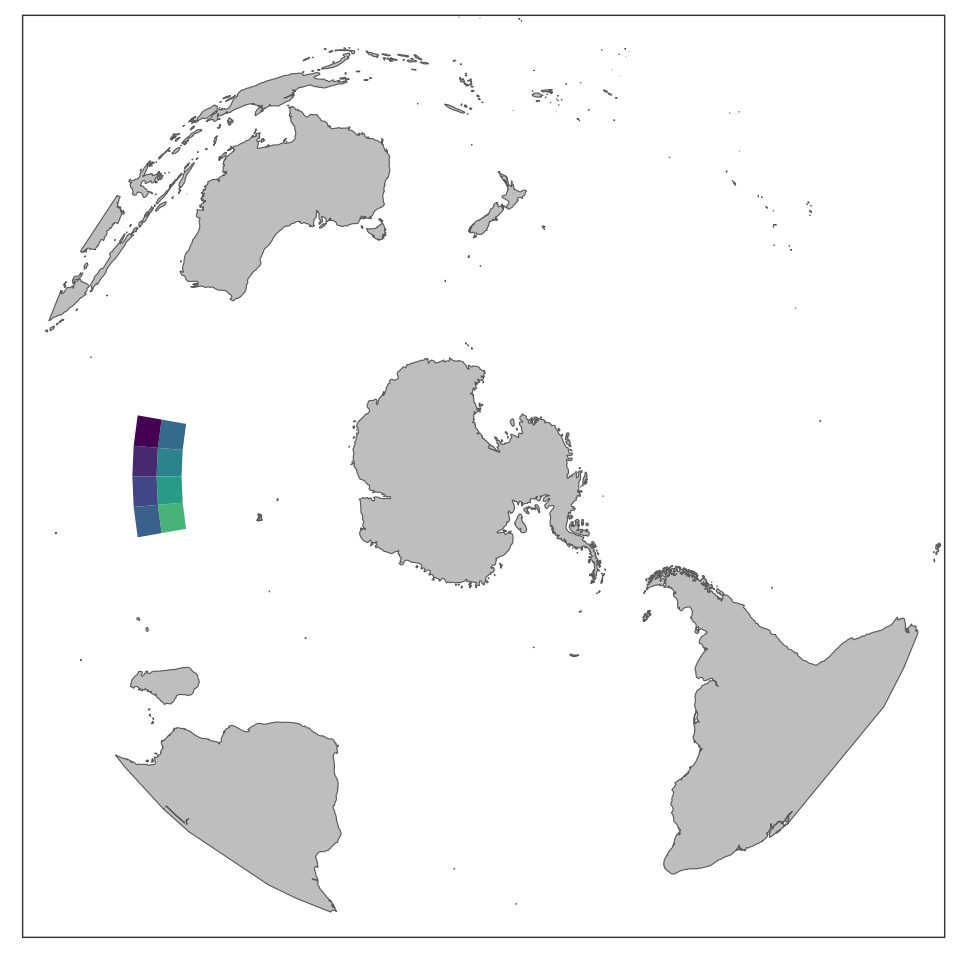
Figure - map of overall observed effort
# Map of observed effort by month

# get observed effort by cell
plt_dat <- obs_data %>%
  st_drop_geometry(.) %>%
  group_by(., id_cell, id_month) %>%
  summarise(., observer_effort = sum(observer_effort)) %>%
  ungroup(.)

# add geometry from grid
plt_dat <- plt_dat %>% left_join(., grid, by = "id_cell") %>% st_as_sf(.)

# generate plot
plt <- ggplot(plt_dat) +
  geom_sf(aes(fill = observer_effort), col = NA) +
  guides(fill = "none") +
  scale_fill_viridis_c("Observed\neffort", direction = -1, limits = c(0, NA)) +
  facet_wrap(vars(id_month), nrow = 4, ncol = 3) +
  theme_sh()

ggsave(paste0("map_observed_effort_by_month_", flag_str_label, ".png"), plot = plt, device = "png",
       path = figures_path, width = 5, height = 5, units = "in")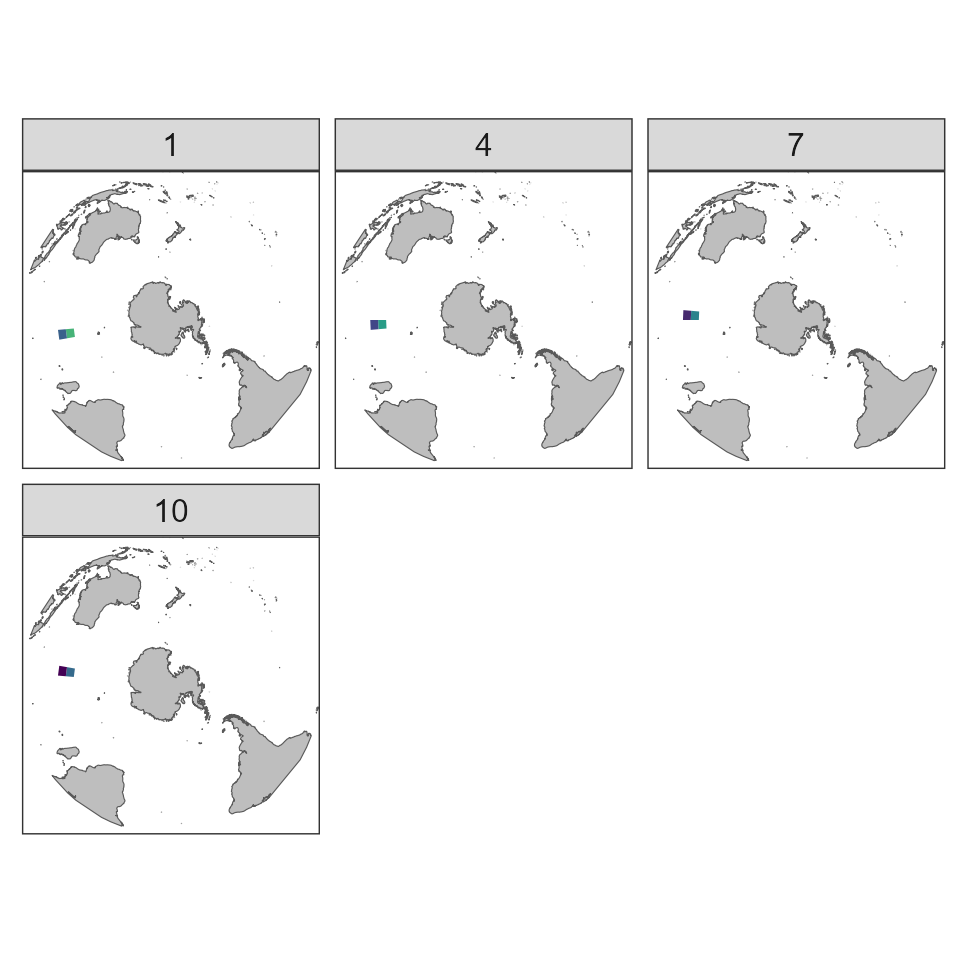
Figure - map of overall observed effort by month
# Map of observed effort by fishery group
if(nrow(lk_fishery_groups) > 1) {

  # get observed effort by cell
  plt_dat <- obs_data %>%
    st_drop_geometry(.) %>%
    group_by(., id_cell, id_fishery_group) %>%
    summarise(., observer_effort = sum(observer_effort)) %>%
    ungroup(.)

  plt_dat <- plt_dat %>% left_join(., lk_fishery_groups, by = "id_fishery_group")

  # add geometry from grid
  plt_dat <- plt_dat %>% left_join(., grid, by = "id_cell") %>% st_as_sf(.)

  # generate plot
  plt <- ggplot(plt_dat) +
    geom_sf(aes(fill = observer_effort), col = NA) +
    guides(fill = "none") +
    scale_fill_viridis_c("Observed\neffort", direction = -1) +
    facet_wrap(vars(fishery_group), nrow = nrow(lk_fishery_groups), ncol = 1) +
    theme_sh()

  ggsave(paste0("map_observed_effort_by_fgroup_", flag_str_label, ".png"), plot = plt, device = "png",
         path = figures_path, width = 5, height = 5.5 * nrow(lk_fishery_groups), units = "in")
}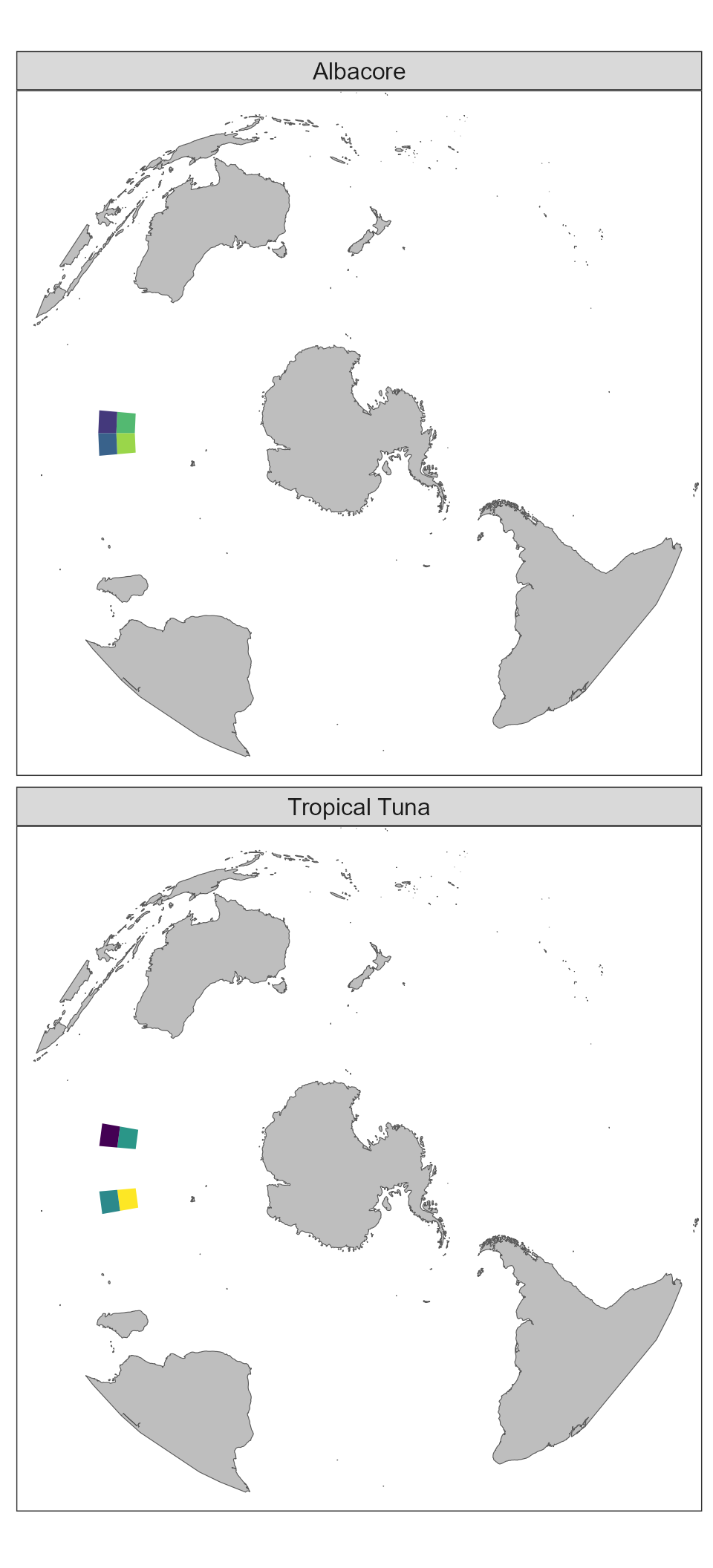
Figure - map of overall observed effort by fishery group
# Map of observed effort by time period
if(nrow(lk_time_periods) > 1) {

  # get observed effort by cell
  plt_dat <- obs_data %>%
    st_drop_geometry(.) %>%
    group_by(., id_cell, id_period) %>%
    summarise(., observer_effort = sum(observer_effort)) %>%
    ungroup(.)

  plt_dat <- plt_dat %>% left_join(., lk_time_periods, by = "id_period")

  # add geometry from grid
  plt_dat <- plt_dat %>% left_join(., grid, by = "id_cell") %>% st_as_sf(.)

  # generate plot
  plt <- ggplot(plt_dat) +
    geom_sf(aes(fill = observer_effort), col = NA) +
    guides(fill = "none") +
    scale_fill_viridis_c("Observed\neffort", direction = -1) +
    facet_wrap(vars(period), nrow = nrow(lk_time_periods), ncol = 1) +
    theme_sh()

  ggsave(paste0("map_observed_effort_by_period_", flag_str_label, ".png"), plot = plt, device = "png",
         path = figures_path, width = 5, height = 5.5 * nrow(lk_time_periods), units = "in")
}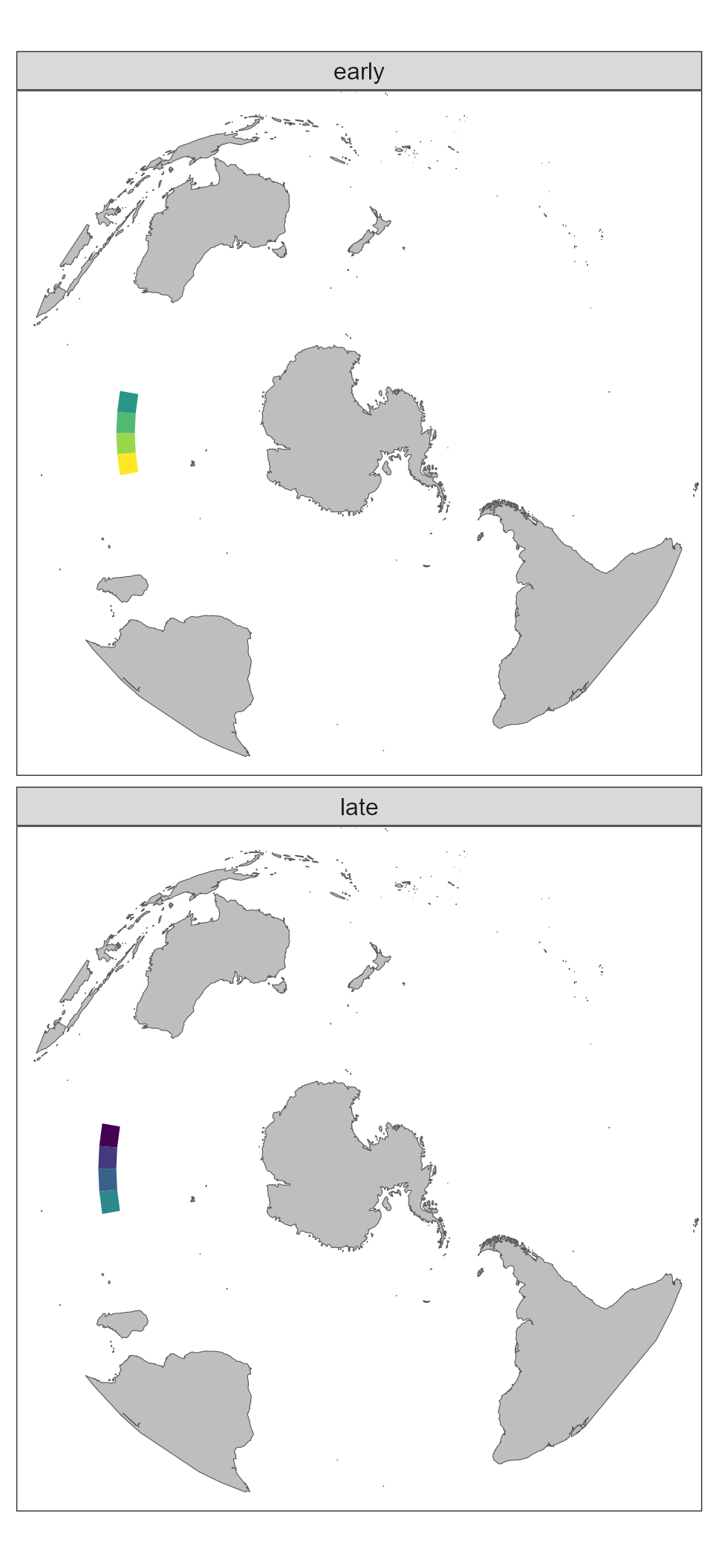
Figure - map of overall observed effort by time period
Save prepared data
Save processed observer data at a raw (i.e., un-aggregated) resolution:
save(obs_data, file = file.path(dir_data, "obs_data.rda"))
save(obs_overlap, file = file.path(dir_data, "obs_overlap.rda"))
obs_data and obs_overlap are not required
as an input for the risk assessment model, but may be of interest to the
User.
Issues preparing your data
If you encounter any issues preparing your observer dataset, please
create a new Issue for
the sefraInputs Github repository with a description of
the problem, including any error messages, and one of the project team
will assist.